
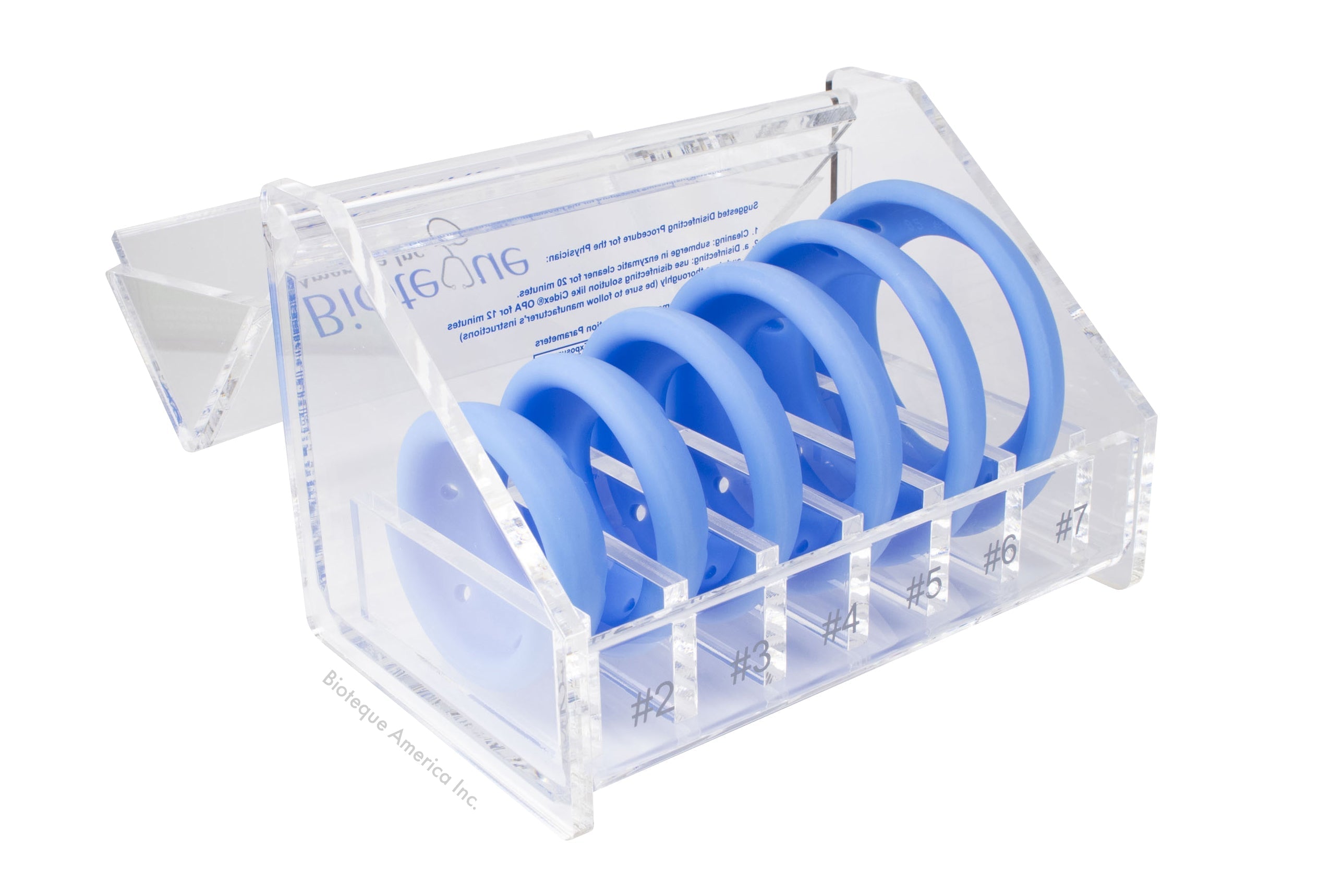
Anterior vaginal wall prolapse is the most common compartment presentation in symptomatic pelvic organ prolapse — and the ring with support pessary has earned its place as the standard first-line device for most cystocele presentations. The challenge is knowing when that default is sufficient, when the dish pessary is the better fit, and when anatomy demands escalation to a space-filling option. This guide covers the clinical selection logic, the relevant POP-Q measurements, and the cystocele-specific caveat that catches clinicians off guard: occult stress urinary incontinence.
In this guide:
- What anterior vaginal wall prolapse is and how to stage it with POP-Q
- Ring with support: mechanism, indications, and fitting considerations
- Dish pessary: when a broader support platform is the right choice
- Side-by-side comparison of ring with support vs. dish
- Escalation criteria and when to move to a space-filling pessary
- Occult stress urinary incontinence: the cystocele-specific clinical caveat
What Is Anterior Vaginal Wall Prolapse (Cystocele)?
A cystocele is the herniation of the anterior vaginal wall, allowing the bladder to descend into the vaginal canal. When the urethra descends concurrently — as it frequently does — this is termed a urethrocele. Most symptomatic presentations involve both structures to some degree. Anterior wall involvement is present in the majority of symptomatic POP presentations, making it the most commonly encountered prolapse compartment.
Symptoms your patient may report include:
- Vaginal bulge or pressure, particularly after prolonged standing
- Voiding difficulty — hesitancy, incomplete emptying, positional stream changes
- Urinary urgency or frequency from bladder base displacement
- Incomplete bladder emptying with elevated postvoid residual
Symptom burden correlates poorly with stage in early prolapse but becomes consistently significant once the anterior wall reaches or descends beyond the hymen, corresponding to POP-Q stage II or higher at the Ba measurement point.
POP-Q Assessment of the Anterior Compartment: What the Numbers Mean
Two POP-Q measurement points define the anterior compartment. Point Aa is fixed at 3 cm proximal to the hymen on the anterior midline; its range is −3 to +3 cm. Point Ba is the most distal portion of the upper anterior vaginal wall. Ba drives staging for the anterior compartment:
- Stage I: Ba < −1 cm (above the hymen; minimal symptoms)
- Stage II: Ba between −1 cm and +1 cm (at or near the hymen; typically symptomatic)
- Stage III: Ba > +1 cm (prolapse extends below the hymen)
Beyond Ba, two additional measurements guide pessary selection. Genital hiatus (GH) greater than 4 cm independently predicts ring pessary failure, even when the anterior wall is the dominant compartment. Total vaginal length (TVL) below 6 cm limits size options. During examination, assess the anterior wall’s reducibility: if the wall cannot be manually repositioned with moderate pressure, a space-filling pessary may be a better starting point than a support pessary. The AUGS interactive POP-Q assessment tool provides a useful staging reference for the clinical team.
Ring with Support Pessary — First-Line for Anterior Wall Prolapse
The ring with support pessary is a silicone ring fitted with an integrated support membrane that bridges the anterior defect and elevates the bladder base. The ring seats on the posterior vaginal fornix and pubic symphysis, restoring anatomical position through elevation, with the membrane specifically addressing the anterior compartment defect.
It is first-line for most cystocele presentations because:
- Clinician fitting is straightforward and achievable in a single appointment
- Many patients can be taught self-insertion and removal
- Sexual intercourse is possible with the device in situ
- It is available in a comprehensive Ring with Support Fitting Set
- Long-term patient tolerance is well-documented in cohort data
The PESSRI trial (Cundiff et al., Am J Obstet Gynecol, 2007) — a randomized crossover study of ring with support versus Gellhorn in 134 women with a median POP-Q stage III — found that both pessaries produced statistically and clinically significant improvements in PFDI and PFIQ scores, with no clinically significant difference between the two. Fitting success and patient tolerability, not shape hierarchy, should drive initial selection. Sizing for most patients falls between ring with support sizes 3 and 5; begin with a size estimated from TVL and GH, then verify retention with Valsalva and ambulation before the patient leaves.
Explore Minerva’s Prolapse Solutions collection for the full range of ring-family pessaries and fitting kits.
Dish Pessary — A Broader Support Platform
The dish pessary is a flat-profile silicone disc with a broad support surface and, in some variants, fenestrations for drainage. Its contact area is larger than the ring, distributing support across more of the anterior vaginal wall. This makes it a suitable alternative when the ring with support fails to achieve sufficient elevation or when patient anatomy favors a broader base.
Clinical indications for the dish over the ring with support:
- Mild-to-moderate anterior prolapse (stage I–II) where the ring produces localized pressure rather than even support
- Patients with a slightly widened introitus who still have adequate posterior fornix depth
- Situations where the ring with support membrane causes anterior discomfort or seats imprecisely
The dish is also available with a knob for patients with concurrent stress urinary incontinence. The standard dish (without knob) allows sexual intercourse; the knob variant typically does not when in situ. Fitting technique: compress gently for insertion, seat the posterior edge in the posterior fornix, and confirm the anterior face supports the bladder base. Available at Minerva: Dish Pessary.
Ring with Support vs. Dish Pessary: Comparison
| Feature | Ring with Support | Dish Pessary |
|---|---|---|
| Mechanism | Elevation + anterior membrane support | Broad surface contact support |
| Self-management feasibility | Moderate–high | Moderate |
| Allows sexual intercourse | Yes | Yes (standard; no with knob variant in situ) |
| Best prolapse stage | II–III anterior | I–II anterior |
| GH tolerance | Up to ~4 cm | Up to ~3.5 cm |
| Fitting set available | Ring with Support Fitting Set | Dish Fitting Set |
| SUI variant available | Ring with Knob (separate shape) | Dish with Knob |
Takeaway: The ring with support is the appropriate first-line choice for most cystocele presentations; the dish is a suitable alternative when a broader support surface is preferred for mild-to-moderate anterior prolapse.
When to Escalate Beyond Support Pessaries
Several clinical findings reliably predict that a support pessary will fail in the anterior-dominant prolapse patient:
- Ba > +3 cm — advanced anterior wall descent that a support mechanism cannot reliably hold
- GH > 4 cm — introital width exceeds the range where a ring or dish maintains stable seating
- TVL < 6 cm — limited depth prevents adequate posterior fornix seating
- Recurrent expulsion despite correct size selection across multiple ring with support sizes
- Concurrent uterine or apical descent complicating the anterior defect
When escalation is warranted, the Gellhorn pessary is the next step. Its concave disc base creates suction against the vaginal walls at the apex, providing anterior support through positional stabilization rather than membrane elevation. Before changing shapes, always exhaust within-shape sizing: a ring with support that expels at size 4 may be retained at size 5. For patients with combined anterior and apical descent, refer to the guide to pessary selection for uterine and apical prolapse for Gellhorn fitting considerations. The StatPearls Pelvic Organ Prolapse overview provides additional background on compartment anatomy and escalation logic.
Occult Stress Urinary Incontinence: The Cystocele Caveat
One of the most clinically important aspects of cystocele management with a pessary is the unmasking of latent stress urinary incontinence. When the anterior vaginal wall descends, the urethra is mechanically kinked, creating a functional outlet obstruction that masks SUI present before the prolapse developed. Once a well-fitted pessary reduces the cystocele and restores normal anatomical alignment, that urethral kinking resolves — and the underlying SUI becomes clinically apparent.
The practical workflow:
- Perform a cough stress test before pessary fitting, with the prolapse manually reduced, to screen for occult SUI
- Repeat the cough stress test after pessary placement before the patient leaves the clinic
- If SUI is unmasked: discuss adding a knob variant or incontinence-specific pessary to the management plan
- If SUI is significant and persistent: consider referral for urodynamic evaluation and combined surgical planning
For concurrent SUI management, the Ring with Knob Pessary is designed to provide anterior support while compressing the urethra against the pubic symphysis. This is primarily an incontinence device — selection should be guided by whether SUI or prolapse symptoms are the dominant complaint. Additional context on pessary use in combined POP and SUI presentations is available from the IUGA expert opinion on vaginal pessaries in POP management.
Follow-Up and Self-Management for Anterior Prolapse Patients
The ring with support’s compatibility with patient self-management is a clinical asset that requires structured teaching. During the first or second visit, demonstrate insertion and removal with the patient and document their successful attempts before releasing them to self-care. Patients who cannot achieve self-management should default to a clinician-managed schedule.
Recommended follow-up schedule:
- 1–2 weeks post-initial fitting: confirm comfort, retention, and absence of voiding difficulty; repeat cough stress test
- Every 3–6 months for non-self-managing patients: cleaning, mucosal inspection, and refitting assessment
- Every 6–12 months for adherent self-managing patients: mucosal inspection and fit assessment
Instruct patients on contact-triggering symptoms requiring early reassessment: new vaginal bleeding, persistent foul odor not responsive to cleaning, inability to void, pessary not retained, or significant pelvic pain. Reinforce that a pessary manages prolapse symptoms — it does not anatomically repair the defect. Adherence to follow-up prevents the most serious complications: mucosal erosion, vaginal ulceration, and pessary incarceration. For a broader discussion of non-surgical versus surgical management, see the pessary vs. surgery counseling framework. Additional context on posterior compartment presentations is covered in Minerva’s existing post Restoring Comfort: A Comprehensive Guide to Rectocele.
Frequently Asked Questions
Which pessary works best for a cystocele?
There is no universally best pessary for anterior wall prolapse. The ring with support is the appropriate first-line option for most stage II–III cystocele presentations due to its ease of fitting, patient self-management compatibility, and equivalent symptom relief compared to space-filling devices in clinical trials. The dish is a suitable alternative for mild-to-moderate anterior prolapse when a broader support surface is preferred. Escalation to a Gellhorn is indicated when Ba exceeds +3 cm, GH exceeds 4 cm, or repeated ring trials fail. Selection always requires clinical examination — no pessary should be prescribed without fitting.
Can a ring pessary correct a cystocele?
A ring pessary — specifically the ring with support variant — manages cystocele symptoms by elevating the anterior vaginal wall and supporting the bladder base. It does not repair the underlying fascial defect or restore the anatomy. Patients should understand that symptom relief with a well-fitted pessary is genuine and sustainable, but discontinuation will result in return of symptoms. For patients seeking anatomical correction, surgical consultation is appropriate.
What size ring with support pessary is used for a cystocele?
Most patients with anterior wall prolapse fit a ring with support in sizes 3 through 5. The starting size is estimated from TVL, GH, and anterior wall dimensions on examination. The correct size allows retention through Valsalva and ambulation with approximately 1 cm of space between the ring and the vaginal wall. If the initial size expels, increase one size before changing shapes. Use a comprehensive Ring with Support Fitting Set rather than ordering individual sizes sequentially.
Can a cystocele cause urinary leakage after a pessary is fitted?
Yes — this is often occult SUI being unmasked rather than pessary-induced incontinence. When the pessary reduces the anterior prolapse, urethral kinking resolves, and pre-existing stress incontinence that was masked by the prolapse becomes apparent. A post-fitting cough stress test is mandatory before the patient leaves the clinic. If SUI is confirmed, management options include a ring with knob or dish with knob, or referral for urodynamic evaluation if the SUI burden is significant.
How often should a pessary be changed for anterior wall prolapse management?
The pessary should be cleaned and inspected at every follow-up visit — typically every 3–12 months depending on whether the patient self-manages. Physical replacement is generally needed every 1–3 years, though this varies with device condition. At each visit, assess for signs of degradation and refit if the device no longer maintains retention. Follow AUGS and ACOG guidance on refitting intervals rather than applying a fixed calendar-based replacement schedule.
This article is for informational purposes for healthcare professionals. It does not constitute medical advice or replace clinical judgment. Always follow your institution’s protocols and the manufacturer’s instructions for use.