
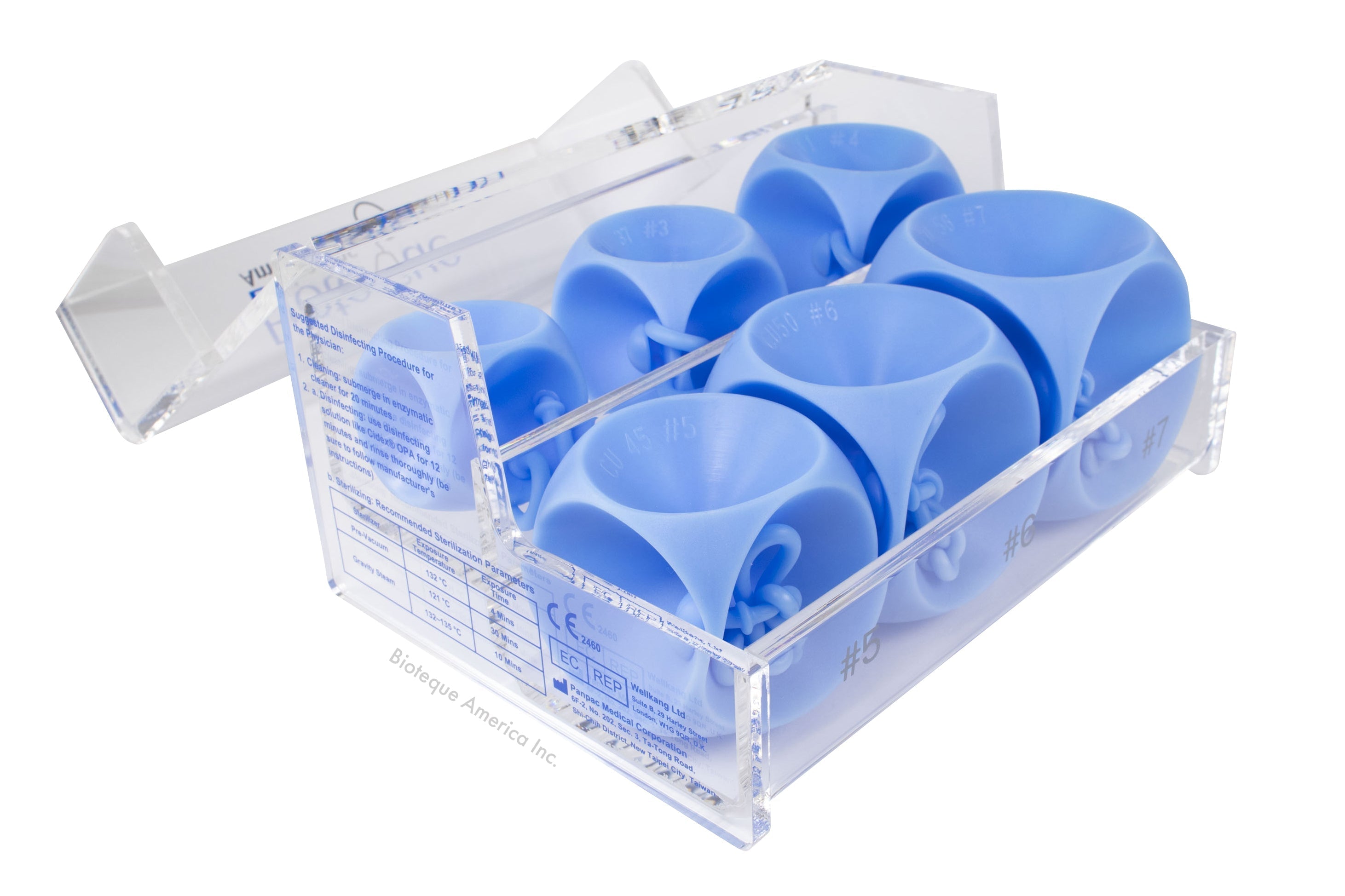
Stage 3 and 4 pelvic organ prolapse is where the clinical stakes are highest: the leading edge is past the hymen, pelvic floor support is severely compromised, and symptoms — constant vaginal bulge, voiding difficulty, mucosal ulceration — demand action. Surgery is the definitive repair, but for elderly patients, those with significant comorbidities, those on long-term anticoagulation, or those who prefer to avoid an operating room, the pessary is a well-evidenced, guideline-supported management option.
Defining Stage 3 and 4 POP
Per the POP-Q system (ICS, AUGS, SGS consensus):
- Stage 3: Most distal leading edge more than 1 cm beyond the hymen but no further than TVL − 2 cm.
- Stage 4: Leading edge at or beyond TVL − 2 cm — complete or near-complete eversion. Procidentia describes combined stage 4 descent of all compartments.
Wide genital hiatus and compromised pelvic floor make support pessaries (ring, dish) unreliable at this stage: when GH exceeds 4 cm, they are expelled during Valsalva or ambulation. Space-filling pessaries function by suction or volume without relying on posterior fornix support — which is why Gellhorn, Cube, and Donut are the relevant shapes here.
Is a Pessary Appropriate at Stage 3 or 4?
Yes. ACOG recommends offering a pessary as an alternative to surgery at all prolapse stages. The Cochrane 2020 systematic review (Bugge et al.) — 4 RCTs, 478 women, populations including advanced prolapse — found pessary plus pelvic floor muscle training probably improves POP symptoms and prolapse-specific quality of life compared with pelvic floor muscle training alone (RR 2.15, 95% CI 1.58–2.94; moderate-certainty evidence).
Scenarios where pessary management is appropriate at stage 3–4:
- Patient preference for non-surgical management after full counseling
- Surgical risk elevation: frailty, cardiovascular or pulmonary comorbidity, BMI above 40
- Long-term anticoagulation where interruption carries prohibitive risk
- Active vaginal ulceration requiring mucosal healing before surgery
- Surgical waitlist: pessary provides symptom relief while awaiting scheduling
- Preoperative SUI assessment: 6–8 weeks of pessary use to clarify occult stress incontinence before planning combined repair
Browse Minerva’s Prolapse Solutions collection for the space-filling pessary shapes discussed in this guide.
Pre-Fitting Assessment for Advanced Prolapse
Fitting a stage 3–4 patient requires deliberate pre-fitting assessment before attempting placement:
- Empty the bladder; assess postvoid residual if voiding difficulty is reported
- Inspect vaginal mucosa for ulceration — active ulceration is a relative contraindication; treat with low-dose topical estrogen for 4–6 weeks first
- Measure TVL and GH: TVL below 6 cm significantly limits options; GH above 4 cm predicts support pessary failure
- Manually reduce the prolapse to assess reducibility and anatomical distortion
- Identify the dominant compartment (anterior, posterior, or apical) to guide shape selection
- Perform a cough stress test after manual reduction to screen for occult SUI
Gellhorn Pessary — Primary Choice for Stage 3–4
The Gellhorn pessary is the most widely prescribed space-filling pessary for advanced pelvic organ prolapse. Its concave disc base creates suction against the vaginal apex; the central stem prevents axial rotation and resists expulsion even when pelvic floor musculature provides minimal active support.
Fitting considerations for advanced prolapse:
- Most stage 3–4 patients are fitted at 2.5 or 2.75 inch disc diameter; confirm a 1 cm circumferential space between disc rim and vaginal wall
- Test retention with Valsalva, coughing, and brief ambulation before concluding the visit
- Long-stem Gellhorn variant: appropriate when the standard stem results in recurrent expulsion or when apical anatomy is deep — the longer lever arm provides additional retention in difficult anatomy
- Most patients require clinician removal at follow-up; establish this expectation at fitting and build it into care planning
The Gellhorn Fitting Set provides systematic size trials to reduce initial fitting time.
Cube and Donut — When the Gellhorn Is Not Sufficient
The Cube pessary is indicated when the Gellhorn cannot be retained despite correct sizing — typically in patients with very wide GH, markedly reduced TVL, or severe multicompartment prolapse. Six concave silicone faces create distributed suction against the vaginal walls without requiring a defined apex for anchorage. The Cube is the last-resort space-filling option before surgical referral. Discharge accumulation in the concave faces requires daily or nightly removal and cleaning; patients who cannot self-remove need frequent clinician access. The retrieval string must be patient-visible at all times.
The Donut pessary fills the vaginal lumen as a solid silicone torus — the cervix rests behind it, limiting further uterine descent. Stage 2–3 uterine prolapse with large GH, or patients who do not tolerate the Gellhorn stem, are the primary indications. TVL below 6 cm precludes use.
| Pessary | Stage | Mechanism | Clinician removal | Best indication |
|---|---|---|---|---|
| Gellhorn (standard stem) | III–IV | Suction disc + stem | Usually yes | Apical, vault, moderate-to-advanced |
| Gellhorn (long-stem variant) | III–IV | Suction disc, deep placement | Yes | Deep vault, standard stem expulsion |
| Cube | III–IV (last resort) | Distributed suction | No (string retrieval) | Failed Gellhorn; severe multicompartment |
| Donut | II–III (uterus present) | Solid torus volume fill | No (technically demanding) | Stage 3 uterine prolapse, large GH |
Takeaway: For stage 3–4 prolapse, the Gellhorn is the appropriate starting point; the long-stem variant addresses deep vault anatomy; the Cube is reserved for cases where the Gellhorn fails to be retained despite correct sizing.
Escalation Triggers and Surgical Referral
Failing multiple pessary shapes across documented fitting attempts is the clearest indication for surgical consultation. Practical escalation triggers include:
- No pessary shape retained across at least three fitting sessions with different shapes and sizes
- Recurrent severe mucosal erosion unresponsive to topical estrogen and shortened follow-up intervals
- Active ulceration or bleeding that does not resolve with pessary removal and conservative management
- New-onset urinary retention or obstructed defecation not resolved by pessary adjustment
The Pessary Assistant reduces the barrier of Gellhorn retrieval for patients near the threshold of self-management capacity. For additional clinical context see the PMC review of pessary indications across POP, and for detailed counseling guidance see the companion post on pessary versus surgery for pelvic organ prolapse.
Managing Complications in Advanced Prolapse Patients
Stage 3–4 patients carry elevated complication risk from atrophic mucosa in prolonged device contact and anatomical instability.
Mucosal erosion: Remove the pessary, apply topical estrogen for 4–6 weeks, and refit after confirmed mucosal healing. Low-dose vaginal estrogen throughout pessary use reduces baseline erosion risk in postmenopausal patients.
Urinary retention and de novo SUI: Confirm voiding before the patient leaves after any Gellhorn fitting. Advanced prolapse mechanically kinks the urethra — once reduced by the pessary, latent SUI may emerge. Document the post-fitting cough stress test result and address unmasked SUI with a ring-with-knob variant if indicated.
Pessary incarceration: The consequence of prolonged follow-up non-attendance. Follow-up should be every 3–4 months minimum at this severity level — the 6–12 month interval appropriate for self-managing stage 1–2 patients is not safe here.
Cross-reference the POP-Q staging and pessary selection algorithm for the full decision framework linking stage, compartment, and GH measurement to pessary choice.
Frequently Asked Questions
Can a pessary manage stage 3 prolapse long-term?
Yes. ACOG supports pessary use as a definitive strategy at all POP stages, and the Cochrane 2020 review demonstrates meaningful symptom improvement. Approximately 60–70% of patients continue at one year; long-term rates decline primarily from desire for surgery or inability to self-manage. Annual review of goals and surgical eligibility is appropriate for any advanced-stage patient.
What is the best pessary for stage 4 prolapse?
The Gellhorn is the standard first-line space-filling choice. If it cannot be retained despite correct sizing, the Cube is the next option. TVL, GH, dominant compartment, prior hysterectomy status, and self-management capacity all inform the final shape — anatomy drives the decision more than stage number alone.
What should be assessed before fitting a pessary in a patient with severe prolapse?
Assess for active ulceration, measure TVL and GH, check post-void residual, manually reduce the prolapse to evaluate reducibility, identify the dominant compartment, and perform a cough stress test for occult SUI. Document all findings before attempting placement.
Why does a ring pessary fail in advanced prolapse?
Support pessaries depend on the posterior vaginal fornix and pubic symphysis for anchorage. At stage 3–4, GH typically exceeds 4 cm and posterior fornix depth is insufficient to hold a ring during Valsalva. Space-filling pessaries function by suction or volume without relying on posterior fornix support, which is why they are appropriate when support pessary anatomy has failed.
When should a patient with stage 3–4 prolapse be referred for surgery?
Surgical referral is appropriate when the patient prefers definitive repair after full counseling, when no pessary shape is retained across multiple fitting sessions, when recurrent erosion cannot be managed conservatively, or when a concurrent surgical indication exists. Pessary use and surgical referral are not mutually exclusive — pessary management during waitlist or preoperative optimization is a routine scenario.
This article is for informational purposes for healthcare professionals. It does not constitute medical advice or replace clinical judgment. Always follow your institution’s protocols and the manufacturer’s instructions for use.