
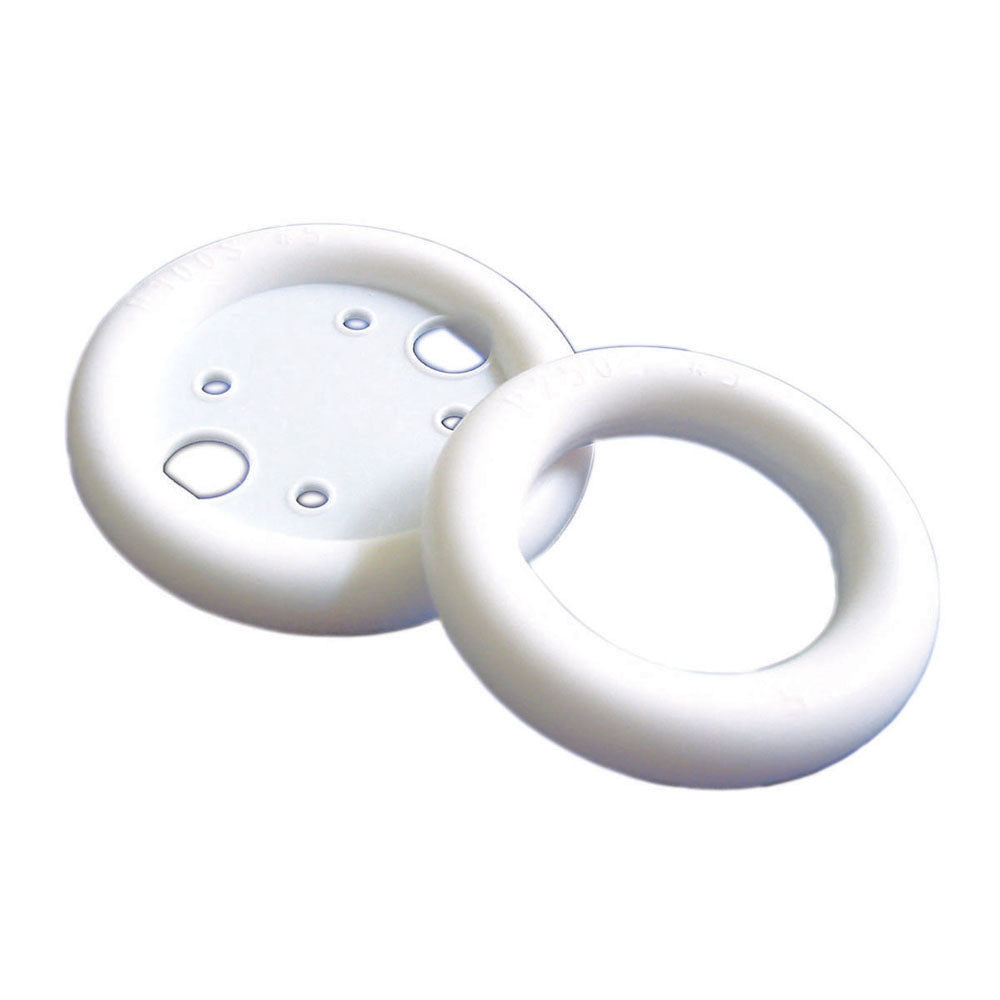
Shape mismatch is the most common reason a pessary trial fails. Correct selection depends on the compartment(s) of prolapse, POP-Q stage, vaginal length and introitus caliber, presence of stress urinary incontinence (SUI), and patient capacity to self-manage. A vaginal pessary must be fitted by a trained clinician — shape and size selection requires pelvic examination.
Why Shape Selection Matters — The Clinical Stakes
The Bugge et al. Cochrane 2020 review identified vaginal length less than 7.5 cm and large hiatal area on Valsalva as the strongest predictors of pessary failure regardless of shape. The ACOG Practice Bulletin 214 (2019) recommends pessaries as first-line conservative management for symptomatic POP at all stages, leaving shape selection to clinician judgment. This guide covers all 12 shapes in the Minerva catalog, grouped by functional category, with a comprehensive decision table and anatomy-based selection criteria. For sizing technique and fitting kit selection, see the pessary sizing and fitting workflow.
Support Pessaries — Shapes That Rest on the Pubic Symphysis
Support pessaries are held by the pubic symphysis, do not occlude the vaginal canal, and are generally compatible with intercourse and self-management. The category includes the Ring, Ring with Support, Ring with Knob, Dish, Hodge, and Gehrung.
- Ring: The most widely prescribed first-line shape for mild-to-moderate POP across all compartments; self-manageable; sizes 2–7 via the Ring Fitting Set. See the Ring Pessary.
- Ring with Support: Adds a central membrane for anterior wall support; preferred when a cystocele component is present. The PESSRI randomized crossover trial found it equivalent to the Gellhorn for symptom relief in moderate-to-advanced prolapse. Available via the Ring with Support Fitting Set.
- Ring with Knob: Incorporates a silicone knob that compresses the urethra against the symphysis; the most commonly used shape for combined POP and SUI. Knob must be positioned anteriorly (12 o’clock) at fitting. See the Ring with Knob Pessary.
- Dish: Shallow, low-profile support for mild anterior prolapse; comfortable for active patients; self-manageable. See the Dish Pessary.
- Hodge: Curved lever pessary for posterior wall support and uterine retroversion. See the Hodge Pessary.
- Gehrung: Arched pessary for rectocele and enterocele; second-line when ring-type shapes fail to provide posterior support. See the Gehrung Pessary.
Space-Filling Pessaries — Shapes That Occupy Vaginal Space
Space-filling pessaries maintain position through suction or volume. Reserved for advanced prolapse, anatomy where support pessaries are not retained, or failed ring trials. Most require clinician-assisted removal and are incompatible with vaginal intercourse.
- Gellhorn: Standard escalation for moderate-to-advanced POP (stage 2–4); long-stem and short-stem variants available. The PMC6096563 cohort found posterior prolapse predicts Gellhorn fit failure. See the Gellhorn Pessary.
- Cube: Six-sided suction device; highest retention; appropriate for severe prolapse or wide introitus where other shapes fail. Requires nightly removal and cleaning in most protocols — non-compliant patients are not candidates. See the Cube Pessary and Cube Fitting Set.
- Donut: Thick torus for uterine prolapse with wide introitus; requires clinician removal. See the Donut Pessary.
- Oval / Mar-Land: Oval-profile support rings for patients where a standard ring is not retained; self-manageable in many patients. See the Oval and Mar-Land Pessaries.
- Shaatz: Rigid ring variant for wide vaginal vault where a standard ring lacks lateral support; requires clinician removal. See the Shaatz Pessary.
Incontinence-Specific Shapes — Knob and Dish Variants
Knob-bearing pessaries compress the proximal urethra against the pubic symphysis during exertion. The Ring with Knob is the first-line choice for combined POP and SUI; the Dish with Knob is used when SUI is the dominant complaint without significant prolapse. Confirm continence with a cough test before the patient leaves the clinic. A review of pessary use in stress urinary incontinence (PMC5909791) supports knob-bearing devices as a conservative option before surgical management.
The 12-Shape Decision Table
| Shape | Category | Primary Indication | Self-Manageable? | Intercourse Compatible? | First-Line or Escalation? | Minerva Product |
|---|---|---|---|---|---|---|
| Ring | Support | Mild–moderate POP (any compartment) | Yes | Yes | First-line | Ring Pessary |
| Ring with Support | Support | Mild–moderate POP with anterior wall component | Yes | Yes | First-line | Ring Pessary |
| Ring with Knob | Support + incontinence | POP + SUI (mixed) | Yes (trained) | Yes (knob may cause discomfort) | First-line for mixed POP/SUI | Ring with Knob |
| Dish | Support | Low-grade anterior prolapse; active patients | Yes | Yes | First-line (anterior) | Dish Pessary |
| Dish with Knob | Support + incontinence | SUI without significant prolapse | Yes (trained) | Possible | First-line for SUI-dominant | Dish Pessary |
| Hodge | Support | Posterior wall support, uterine retroversion | Yes (trained) | Possible | First/second-line (posterior) | Hodge Pessary |
| Gehrung | Support | Rectocele, enterocele | Usually clinician | Possible | Second-line (posterior) | Gehrung Pessary |
| Gellhorn | Space-filling | Moderate–advanced POP, stage 2–4 | Clinician removal | No | Escalation | Gellhorn Pessary |
| Cube | Space-filling | Severe POP, wide introitus, ring/Gellhorn failure | Clinician (nightly self-remove protocol available) | No | Escalation | Cube Pessary |
| Donut | Space-filling | Uterine prolapse, wide vaginal introitus | Clinician | No | Escalation | Donut Pessary |
| Oval / Mar-Land | Support | Ring retention failure, oval vault anatomy | Yes | Yes | Second-line | Oval / Mar-Land |
| Shaatz | Space-filling | Wide vaginal vault, ring not retained | Clinician | No | Escalation | Shaatz Pessary |
For most patients presenting with symptomatic POP, begin with a ring or ring with support; escalate to a Gellhorn or cube only when simpler shapes fail to provide adequate support.
Anatomy and Patient Factors That Drive Shape Selection
POP-Q stage guides but does not solely determine shape choice. Key variables include vaginal length (less than 7.5 cm predicts higher failure per Bugge et al. 2020), introitus caliber (large introitus favors donut or cube), prior hysterectomy (may accelerate escalation to space-filling), sexual activity (active patients should receive support pessaries whenever feasible), and self-management capacity. ACOG guidance recommends reassessment every 3–4 months for patients who cannot self-manage and annually for those who can; the AUGS-SUNA 2023 consensus recommends first follow-up within 4 weeks. Patients unlikely to attend scheduled visits are not candidates for space-filling pessaries that require clinician removal.
The Trial Approach — Starting With the Least Complex Option
Fit the least complex option that provides adequate symptom control. The AUGS-SUNA 2023 Clinical Consensus Statement recommends offering a pessary trial to all women with symptomatic POP, including those with anatomical risk factors. Document each attempt — size, shape, and reason for failure — before switching shapes or escalating. The Pessary Fitting Set collection supports systematic trialing across ring, Gellhorn, cube, oval, and Mar-Land shapes.
Cross-Links to Supporting Clusters
- Sizing tables and fitting kit selection: pessary sizing and fitting workflow
- Insertion technique by shape: how to insert a pessary step-by-step
- Gellhorn and cube removal, including stuck pessaries: how to remove a pessary including stuck pessaries
- Cleaning, care protocols, and replacement criteria: pessary cleaning, care, and replacement schedule
- Complication classification and escalation criteria: pessary side effects and complications guide
- Complete indications overview: vaginal pessaries clinical guide
Browse Minerva’s full range via the Prolapse Solutions collection.
Frequently Asked Questions
What is the most commonly prescribed pessary shape?
The ring pessary and ring with support are the most commonly used first-line shapes — self-manageable, intercourse-compatible, and available in a broad size range. The ring with support is preferred when anterior wall support is the primary need, as confirmed by the Bugge Cochrane 2020 review and clinical practice data.
When should a clinician escalate from a ring pessary to a Gellhorn?
Escalation is appropriate when a correctly sized ring or ring with support is not retained during ambulation and Valsalva, or when anatomy makes ring retention unlikely from the outset. The PESSRI trial showed equivalent symptom relief between the two shapes, supporting a conservative escalation pathway. The patient must also be able to attend clinician-assisted removal visits.
Can a patient with a prior hysterectomy use a ring pessary?
Yes. Prior hysterectomy does not exclude ring pessary use, though post-hysterectomy vault prolapse may require earlier escalation to space-filling shapes. The decision should be based on examination findings and anatomical assessment, not surgical history alone.
What pessary shapes are compatible with sexual intercourse?
Support pessaries — Ring, Ring with Support, Ring with Knob, and Dish — are generally compatible with vaginal intercourse. Space-filling pessaries (Gellhorn, Cube, Donut, Shaatz) require removal beforehand. Clinicians should address sexual activity at the initial fitting consultation and select a shape accordingly.
Is the cube pessary appropriate as a first-line option?
No. The cube’s nightly removal protocol and high complication risk with non-adherence make it a shape of last resort, reserved for severe prolapse or wide introitus after ring and Gellhorn trials have both failed. The patient must demonstrate willingness and physical ability to comply with the removal protocol before the cube is selected.
This article is for informational purposes for healthcare professionals. It does not constitute medical advice or replace clinical judgment. Always follow your institution’s protocols and the manufacturer’s instructions for use.