
Pessary removal is the step in pessary management most likely to cause vaginal injury when technique is incorrect. Space-filling pessaries — the Gellhorn, cube, and donut — create suction or multi-point contact with the vaginal walls, and extracting them without first releasing that suction is the most common procedural error. This guide covers removal technique for every major pessary shape, with a dedicated section on the stuck and impacted pessary: recognition, first-line office management, and clear escalation criteria.
Why Removal Technique Matters
Incorrect removal is the most common cause of vaginal injury during pessary management. Ring and dish pessaries are generally straightforward — compress, fold, and withdraw. Space-filling pessaries require an additional step: suction must be released before any traction is applied. The clinical rule: never apply traction to a pessary before confirming suction is released or the ring is fully compressed.
Removing a Ring or Dish Pessary
Ring and dish pessaries are support pessaries and do not create suction. Self-management candidates can learn this technique in the clinical setting.
- Locate the ring with the examining finger; identify the rim at the anterior or posterior edge.
- Hook a finger under the rim.
- Compress the ring (fold inward) and rotate toward the introitus at approximately 45° downward.
- Withdraw gently; if resistance is felt, relubricate and reattempt rather than applying force.
- Inspect the ring for integrity and the vaginal walls for erythema, abrasion, or erosion.
Ring with Knob variant: Technique is identical; the knob at 12 o’clock may require slight rotation to navigate past the pubic symphysis. Confirm the patient can replicate this in the office before initiating a self-management protocol with their ring pessary.
Removing a Gellhorn Pessary
The Gellhorn disc creates suction against the vaginal vault; removal without suction release risks posterior vaginal wall injury.
- Locate the stem with the examining finger.
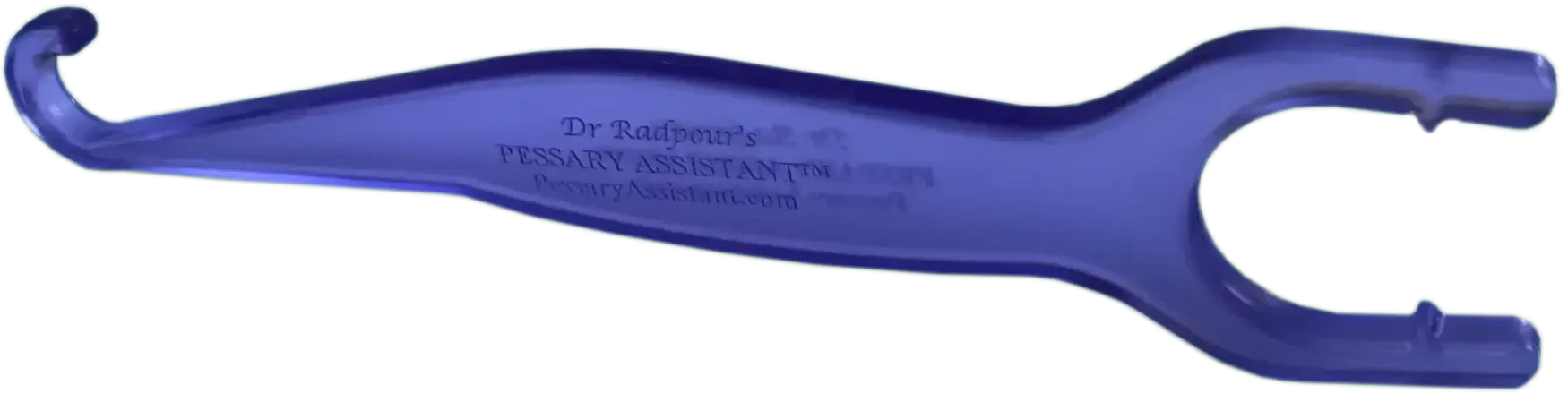
- Grasp the stem firmly. The Pessary Assistant provides mechanical grip in patients with difficult anatomy or where the stem is not easily accessible by finger.
- Rotate the stem gently 90–180° to break suction between the disc and the vaginal walls — this step is non-negotiable.
- Tilt the disc and withdraw at an oblique angle. Do not extract straight back; the disc diameter will engage the posterior vaginal wall.
- Inspect the disc for adherent tissue; inspect vaginal walls for erythema, abrasion, or erosion.
The Pessary Assistant is particularly suited to short-stem Gellhorn removal where finger access is limited.
Removing a Cube Pessary
The cube creates multi-point suction across all six faces — the most technically demanding removal. Most protocols require nightly patient removal; a cube left beyond scheduled intervals should be treated as a high-risk removal.
- Insert a finger and locate the retrieval string or tab.
- Apply gentle, steady posterior traction on the string. Do not jerk — suction cups release sequentially.
- Once descended to mid-canal, compress the cube pessary and withdraw through the introitus.
- If the string is inaccessible, introduce the Pessary Assistant alongside to release the nearest suction cup before traction.
- Inspect all six faces for tissue adherence or discoloration.
Removing Donut, Oval, Hodge, and Gehrung Pessaries
- Donut: Compress the torus partially; rotate toward the introitus with anterior-posterior angling. Do not withdraw with the torus fully expanded.
- Oval / Mar-Land: Hook the narrow edge, compress, and rotate to align the narrow axis with the introitus on withdrawal.
- Hodge: Depress the posterior end to disengage it from the fornix; pivot the anterior end through the introitus.
- Gehrung: Depress the arch to reduce transverse diameter; withdraw at an angle.
Shape-by-Shape Removal Reference
| Shape | Removal method | Suction-breaking required? | Pessary Assistant applicable? | Patient self-removal feasible? |
|---|---|---|---|---|
| Ring / Ring with Knob | Hook rim, compress, withdraw at 45° | No | Optional (limited dexterity) | Yes — preferred self-management shape |
| Dish | Hook rim, compress, withdraw | No | Optional | Yes |
| Gellhorn | Grasp stem, rotate 90–180°, tilt and withdraw obliquely | Yes — mandatory stem rotation | Yes — primary application | Clinician preferred |
| Cube | String traction; sequential suction cup release | Yes — sequential release | Yes — for string access | Nightly per protocol; clinician if string inaccessible |
| Donut | Compress, rotate, withdraw | Partial | Optional | Clinician preferred |
| Oval / Mar-Land | Hook narrow edge, compress, rotate | No | Optional | Yes (trained) |
| Hodge / Gehrung | Lever or arch depression; pivot through introitus | No | No | Clinician preferred |
Ring and dish pessaries are the most suitable for patient self-removal; Gellhorn, cube, and donut typically require a clinician, and the Pessary Assistant is the preferred tool for Gellhorn stem access in difficult presentations.
The Stuck Pessary — Recognition, Assessment, and Management
A stuck or impacted pessary cannot be removed with standard technique due to suction, tissue edema, vaginal atrophy, or partial tissue overgrowth (incarceration). The 19-impression “stuck pessary” query family reflects a genuine clinical scenario, most commonly seen after missed follow-up or prolonged space-filling pessary retention.
Immediate assessment
- Can the pessary be visualized on speculum exam?
- Is there ulceration, granulation tissue, or epithelial overgrowth over the rim?
- Is the patient in pain at rest or on attempted removal?
- What is the estimated time since last removal?
First-line management
Do not apply progressive force. Escalating traction without addressing the cause of retention causes tissue injury. The sequence:
- Topical lidocaine gel or regional analgesia if patient cooperation is limited.
- Relubricate generously around the pessary margin.
- For space-filling shapes (Gellhorn, cube): introduce the Pessary Assistant alongside the pessary to equalize pressure and break the vacuum seal before applying traction.
- For ring pessary: the Pessary Assistant behind the rim provides mechanical advantage that a finger cannot generate against atrophic or edematous tissue.
Second-line management when office attempt fails
- Apply vaginal estrogen cream nightly for 2–4 weeks (postmenopausal patients) to improve tissue pliability; schedule a return visit.
- Reattempt in a procedure room with adequate lighting, nurse assist, and procedural analgesia.
- Per the AUGS-SUNA Clinical Consensus Statement (2023), incarceration is a complication of non-adherent follow-up; the consensus supports referral when office management is not feasible.
Escalation criteria — refer to urogynecology
- Pessary embedded in vaginal epithelium (confirmed incarceration)
- Tissue necrosis at the pessary-epithelium interface
- Patient cannot tolerate office removal with adequate analgesia
- Suspected vesicovaginal or rectovaginal fistula
Per Bugge et al., Cochrane 2020, complications including incarceration are significantly associated with non-adherence to follow-up. Never attempt forcible removal without adequate visualization and analgesia.
After Removal — Inspection and Documentation
Close every removal visit with a structured post-removal assessment:
- Pessary integrity: Examine for cracks, deformation, or surface pitting; persistent odor despite cleaning indicates structural silicone degradation. Browse Minerva’s full pessary range to reorder or trial an alternative shape.
- Vaginal wall inspection: Use a speculum and document using the AUGS-SUNA 4-tier classification: Tier 1 (erythema) — monitor; Tier 2 (abrasion) — consider refitting and local estrogen; Tier 3 (erosion/ulceration) — remove pessary and apply local estrogen before reinsertion; Tier 4 (fistula) — urgent referral.
Per ACOG Practice Bulletin 214, vaginal bleeding, purulent discharge, or visible ulceration are indications for clinical management before reinsertion — not self-management.
Cross-Links and Clinical Summary
Removal is one step in a continuous management cycle:
- For complications identified at removal, see the pessary side effects and complications guide (Cluster 6).
- For cleaning protocol after removal, see the pessary cleaning and care guide (Cluster 5).
- For reinsertion after cleaning, see how to insert a pessary (Cluster 3).
- Return to the vaginal pessaries clinical guide for the full indications overview.
Frequently Asked Questions
What should a clinician do if a ring pessary will not come out?
Relubricate generously and reattempt compression. The Pessary Assistant provides mechanical advantage behind the rim in patients with atrophic or narrowed vaginal tissue. In postmenopausal patients, apply vaginal estrogen cream for 2–4 weeks to improve tissue pliability, then schedule a return visit. Do not apply escalating traction without addressing the cause of retention.
How do you remove a Gellhorn pessary without causing trauma?
Grasp the stem and rotate it 90–180° before applying any axial traction. Rotation breaks the suction between the disc and the vaginal vault. Once suction is released, tilt the disc obliquely and withdraw at an angle — never straight back. The Pessary Assistant is effective for stem access in patients where finger grip alone is insufficient.
What is pessary incarceration and how is it managed?
Pessary incarceration occurs when the pessary becomes embedded in the vaginal epithelium due to prolonged retention without follow-up. Management requires adequate analgesia, adequate lighting, and suction-release technique — not force. When office management fails, refer to urogynecology. Per Bugge et al. (Cochrane 2020), incarceration is closely associated with non-adherence to scheduled follow-up visits.
Can a patient remove a cube pessary at home?
Most clinical protocols require nightly cube pessary removal and cleaning as a condition of fitting. If the patient cannot comply with nightly removal, the cube is not the appropriate shape. If the retrieval string becomes inaccessible, the patient should present for clinical removal rather than attempt unguided instrument retrieval. Non-compliance with the cube removal protocol is the primary risk factor for incarceration.
When should a stuck pessary be referred to a specialist?
Refer to a urogynecologist when: the pessary is embedded in vaginal epithelium (confirmed incarceration); there is tissue necrosis at the contact point; the patient cannot tolerate office removal with adequate analgesia; or there is suspicion of vesicovaginal or rectovaginal fistula. Early referral carries a significantly better outcome than delayed referral following repeated failed attempts.
This article is for informational purposes for healthcare professionals. It does not constitute medical advice or replace clinical judgment. Always follow your institution’s protocols and the manufacturer’s instructions for use.