
Flexible cystoscopy is the highest-volume diagnostic urologic procedure performed in an office setting — hematuria workup, bladder cancer surveillance, LUTS evaluation, indwelling stent surveillance — and it is also the procedure with the deepest published evidence base for nitrous oxide analgesia. Intraurethral lidocaine gel is the standard local anesthetic and remains essential, but a growing body of peer-reviewed evidence supports adding self-administered nitrous oxide at 50% or less in oxygen as a comfort adjunct that improves pain and satisfaction without pushing the encounter into moderate sedation. This guide walks urologists, medical assistants, and cystoscopy techs through the clinical evidence for office cystoscopy specifically, patient selection, workflow, and how the reimbursement picture works when the underlying CPT 52000 is billed to insurance and the nitrous oxide is offered on a cash basis.
Why Nitrous Oxide Belongs in the Cystoscopy Suite
The clinical case for adding nitrous oxide to flexible cystoscopy comes from three observations that any urologist doing surveillance-heavy cystoscopy has already made. First, a meaningful minority of male patients — historically the group with the higher pain scores — describe the procedure as painful enough that they defer surveillance visits or ask for oral sedation the practice does not otherwise offer. Second, the procedure is short enough (typically five to ten minutes) that a rapid-onset, rapid-offset inhaled analgesic is a better fit than any pharmacologic option requiring a driver and a formal recovery period. Third, intraurethral lidocaine gel — the current standard — reduces but does not eliminate procedural pain, particularly at the membranous urethra and the bladder neck, leaving room for a supplemental modality.
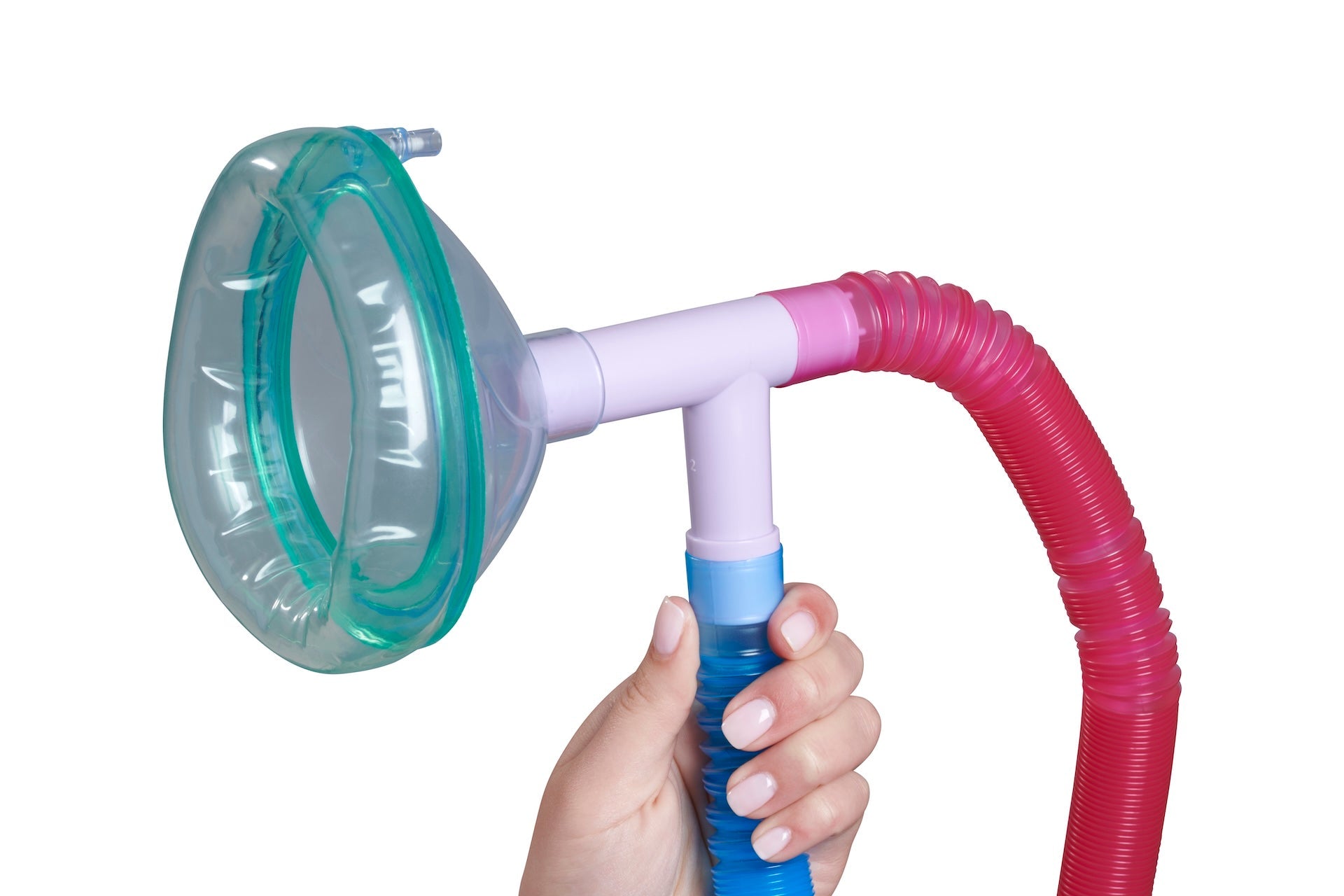
Nitrous oxide at 50% or less in oxygen, self-administered by demand-flow mask, fits all three constraints. Onset is within one to two minutes, offset within a similar window after mask discontinuation, and the patient controls delivery — dropping the mask stops the flow, which is an inherent safety feature. It supplements rather than replaces lidocaine gel, and it stays inside the American Society of Anesthesiologists (ASA) minimal-sedation category, so the practice does not need to build a moderate-sedation infrastructure to offer it. The full clinical and operational framework is covered in the pillar guide to office urology nitrous oxide analgesia.
Evidence Base for Cystoscopy Specifically
The reference RCT for nitrous oxide in flexible cystoscopy is Calleary and colleagues in the Journal of Urology (2007). Sixty-one men under age 55 were randomized to a 50:50 nitrous oxide–oxygen mixture (Entonox) or air, both administered alongside 20 mL of 2% intraurethral lidocaine gel. Cystoscopy pain scores on the visual analog scale were significantly lower with Entonox (p<0.001), side effects were transient, and more patients in the air arm indicated they would require additional analgesia or general anesthesia for a repeat procedure. The trial is nearly two decades old, but it remains the most rigorously conducted head-to-head comparison of Entonox versus placebo in office flexible cystoscopy and has not been superseded by a larger or more recent RCT.
A more current synthesis appears in Łaszkiewicz and colleagues in Contemporary Oncology (2021), a peer-reviewed review of pain reduction strategies for cystoscopy that concluded nitrous oxide provides a significant decrease in procedure-related pain with a favorable side-effect profile. The Gopalakrishna 2020 Urology review of nitrous oxide across urologic procedures reinforces cystoscopy as one of the strongest evidence-based indications and reports adverse events as rare and self-limited across the 11 studies analyzed. An earlier review by Young and colleagues in the Annals of the Royal College of Surgeons of England (2012) examined Entonox in urology broadly and reached compatible conclusions.
Cystoscopy analgesia is not a settled field. A January 2026 double-blind RCT by Wanifuchi and colleagues in the International Journal of Urology reported that patient-controlled irrigation bag squeeze during flexible cystoscopy produced significantly lower pain scores (p=0.0001) and higher satisfaction (p=0.006) versus a sham control, with no infections and no differences in physiological metrics or anxiety reduction. That finding does not compete with nitrous oxide — the mechanisms are different, one is psycho-motor and one is pharmacologic — but it demonstrates that patient-controlled analgesic modalities are actively producing high-quality evidence. Nitrous oxide sits within that same family of self-administered, low-risk, self-limiting interventions that give the patient a lever they can pull during a procedure they cannot otherwise influence.
The American Urological Association guidelines index as of July 2026 does not contain a specific practice guideline on office cystoscopy analgesia, which is why individual RCTs and reviews carry the framework rather than a society position statement.
Patient Selection
Nitrous oxide is a reasonable adjunct to offer any adult patient scheduled for office flexible cystoscopy who does not fall into a contraindication category. Groups most likely to benefit include: first-time cystoscopy patients whose anxiety is procedure-native rather than clinical; surveillance patients on a high-frequency schedule (non-muscle-invasive bladder cancer follow-up, stent surveillance) who have previously described discomfort; patients with previous urethral instrumentation or stricture history; and patients specifically requesting an option beyond lidocaine gel.
Nitrous Oxide Plus Intraurethral Lidocaine — the Combined Standard
Nitrous oxide supplements intraurethral lidocaine gel; it does not replace it. The Calleary 2007 trial delivered both the gel and the Entonox — the pain reduction reported was on top of standard lidocaine anesthesia, not instead of it. That is the operational baseline: 20 mL of 2% lidocaine gel (or the practice’s usual local anesthetic protocol) instilled through the urethral meatus five to ten minutes before scope insertion, with the nitrous oxide mask fitted one to two minutes before insertion and the patient breathing normally through the mask at the moment the scope enters the urethra. The two modalities work through complementary mechanisms — lidocaine blocks urethral nociceptive transmission; nitrous oxide provides central analgesic and anxiolytic effects — so combining them is additive rather than redundant.
Room Setup and Equipment
A cystoscopy room that adds a nitrous oxide program needs three additions beyond the standard cystoscopy setup: the delivery device, an active scavenger, and a documented occupational-exposure monitoring approach. The Nitronox Plus nitrous oxide system, cleared under FDA 510(k) K113687 for spontaneously breathing patients requiring analgesia, is available in fixed 50/50 and adjustable configurations with adult masks, disposable circuits, and a matched scavenger. The fixed 50/50 configuration is the simplest way to maintain the ≤50% ASA minimal-sedation ceiling because the device cannot deliver more.
The cystoscope itself sits alongside the nitrous oxide device rather than integrating with it. Minerva’s office cystoscope options are catalogued at the Tru-Vu Laser Cystoscope catalog — 23 FR sheath, 8 FR working channel, autoclavable stainless-steel construction, and compatibility with Storz, ACMI, and Wolf systems. The cystoscope choice affects optical quality, working-channel capacity, and reprocessing workflow; it does not affect analgesic mechanism. Do not conflate cystoscope selection with pain-management strategy.
Occupational exposure to nitrous oxide is regulated by the NIOSH Pocket Guide REL of 25 ppm time-weighted average. Every cystoscopy room offering nitrous oxide needs an active scavenger connected to the delivery device, adequate room air exchange, and periodic personal or area dosimetry. The scavenger and its consumables must be maintained per the device IFU, and cystoscopy staff who administer or assist with the mask should be included in the practice’s occupational exposure monitoring program. Additional devices and disposables are catalogued in the pain and anxiety management collection.
Procedural Workflow — Adapted for Cystoscopy Timing
The workflow below assumes standard office flexible cystoscopy with intraurethral lidocaine gel and nitrous oxide at 50% or less in oxygen, self-administered, with no other sedative or analgesic. Confirm every step against the device IFU and the practice’s own sedation policy.
- Pre-visit screening. Confirm the patient has no contraindication to nitrous oxide. Flag any patient with recent pulmonary, middle ear, or retinal surgery; bowel obstruction; known cobalamin deficiency; or first-trimester pregnancy.
- Consent. Two distinct consents — one for the cystoscopy per practice standard, one for the cash-pay nitrous oxide comfort service. See the companion article on the cash-pay comfort service program setup for consent and Good Faith Estimate details.
- Baseline vitals. Record heart rate, blood pressure, oxygen saturation. Continuous monitoring is not required at the minimal-sedation level.
- Intraurethral lidocaine. Instill 20 mL of 2% lidocaine gel through the urethral meatus. Allow at least five minutes for anesthetic uptake before scope insertion.
- Initiate nitrous oxide. Fit the demand-flow mask, confirm seal, and instruct the patient to breathe normally. Onset is within one to two minutes. The patient self-holds the mask.
- Perform the cystoscopy. Maintain verbal contact with the patient throughout. A patient who cannot respond appropriately to verbal commands has crossed out of minimal sedation and the encounter shifts to a moderate-sedation protocol.
- Discontinue nitrous oxide and administer 100% oxygen. Per StatPearls, 100% oxygen administration should follow nitrous oxide cessation to prevent diffusion hypoxia. Three to five minutes on 100% O₂ is standard.
- Post-procedure assessment. Confirm return to baseline mentation. Extended recovery monitoring is not required at minimal sedation, and the patient may typically leave without a driver — but confirm this against the practice’s own sedation policy.
- Document. Indication, contraindication screen, both consents, lidocaine dose, nitrous oxide concentration (documented at ≤50%), start and stop times, absence of other sedatives, patient tolerance, adverse events.
Reimbursement — CPT 52000 Plus Cash-Pay Nitrous Oxide
Office flexible cystoscopy is billed under CPT 52000 (cystourethroscopy, separate procedure). Under the Medicare Physician Fee Schedule for CY2026, the national payment amount is $215.77 in the non-facility (office) setting and $71.14 in the facility setting. The cystoscopy is billed and reimbursed as usual per the payer’s fee schedule.
The nitrous oxide is not billed to insurance. Because self-administered nitrous oxide at ≤50% with no other sedative or analgesic is classified as minimal sedation by the ASA continuum of sedation, moderate-sedation CPT codes 99151–99153 do not apply, and per Rubenstein and Painter in Urology Times (2024), “the use of nitrous oxide for urology procedures is a noncovered service.” No CPT or HCPCS code exists to report the office nitrous oxide administration. Practices offer the service as cash-pay with the fee disclosed to the patient at scheduling. The full financial-policy and Good Faith Estimate framework, including the timing rules under the No Surprises Act, appears in the cash-pay comfort service guide.
Two boundary conditions preserve this simplicity: nitrous oxide concentration must remain at or below 50%, and no other sedative or analgesic — including oral anxiolytics — may be administered by any route in the same encounter. Local anesthesia (the intraurethral lidocaine gel) is compatible with the minimal-sedation classification. Adding an oral benzodiazepine or an IV sedative shifts the encounter to moderate sedation, triggering the full ASA moderate-sedation documentation standard and potentially reportable CPT 99151–99153.
Quick-Reference Card — Office Flexible Cystoscopy Nitrous Oxide Program
| Office Flexible Cystoscopy + Nitrous Oxide — Program Elements | |
|---|---|
| Element | Setting or requirement |
| Cystoscopy CPT | 52000 (cystourethroscopy, separate procedure) |
| CY2026 MPFS national payment | Office/non-facility $215.77 · Facility $71.14 |
| Standard local anesthetic | 20 mL 2% intraurethral lidocaine gel (or practice standard); allow ≥5 min uptake |
| Nitrous oxide concentration | ≤50% N₂O in O₂ (fixed 50/50 device or adjustable set below 50%) |
| Sedation classification | Minimal sedation per ASA (with lidocaine local only) |
| Concurrent oral or IV sedatives | None (any addition shifts to moderate sedation) |
| Nitrous oxide billing | Cash-pay comfort service; no CPT or HCPCS applies |
| Good Faith Estimate | Required for uninsured/self-pay commercial patients; not required for Medicare/Medicaid/TRICARE/FEHB |
| Continuous pulse oximetry | Not required at minimal-sedation level; baseline vitals recommended |
| Independent trained observer | Not required at minimal-sedation level |
| Occupational exposure limit | NIOSH REL 25 ppm TWA; active scavenger + dosimetry required |
| Post-cessation oxygen | 100% O₂ for 3–5 minutes to prevent diffusion hypoxia |
| Added procedure time | Typically 5–10 minutes total (mask fit + recovery) |
Frequently Asked Questions
Does nitrous oxide replace intraurethral lidocaine gel?
No. Every published RCT and review supporting nitrous oxide for cystoscopy — Calleary 2007, Łaszkiewicz 2021, Gopalakrishna 2020 — used it alongside standard intraurethral lidocaine gel. The two modalities work through complementary mechanisms and combine additively. Removing lidocaine to offer nitrous oxide alone is not evidence-supported.
Is nitrous oxide appropriate for female patients undergoing flexible cystoscopy?
Female cystoscopy is generally less painful than male cystoscopy because of the shorter urethra, and the evidence base has focused on male patients. Nitrous oxide remains a reasonable option for anxious female patients or those with previous painful cystoscopy experience — subject to the same contraindication screen — but the marginal pain-reduction benefit is smaller than in male patients.
Can we offer nitrous oxide for stent surveillance cystoscopy?
Yes. Stent surveillance patients often present with a documented history of procedural discomfort and are a strong candidate group. Screen for contraindications and confirm no concurrent sedative use. The clinical framework is the same as diagnostic cystoscopy.
What if the patient asks for oral midazolam plus nitrous oxide?
Adding an oral benzodiazepine shifts the encounter to moderate sedation under ASA definitions. At that point continuous pulse oximetry, an independent trained observer, and moderate-sedation documentation are all required, and CPT 99151 or 99152 may become reportable if the full ASA moderate-sedation documentation standard is met and the intra-service time threshold is documented. Most office cystoscopy programs decline this combination to preserve the minimal-sedation workflow.
How much extra time should we block for a cystoscopy with nitrous oxide?
Typically five to ten minutes on top of the standard visit — one to two minutes of mask fitting and onset before scope insertion, and three to five minutes of 100% oxygen recovery afterward. Practices commonly extend the appointment slot rather than trying to compress the timing.
How does the AUA position on office cystoscopy analgesia inform our program?
As of July 2026, no AUA practice guideline specifically addresses office cystoscopy analgesia. The peer-reviewed RCT evidence base — anchored by Calleary 2007 and updated by Łaszkiewicz 2021 and Gopalakrishna 2020 — carries the clinical framework, alongside the ASA sedation continuum for classification and the NIOSH REL for occupational safety.
This article is for informational purposes for healthcare professionals. It does not constitute medical, coding, or legal advice, and it does not replace clinical judgment. Always follow your institution’s protocols, state regulations, and the manufacturer’s Instructions for Use. Sedation classification, patient selection, and reimbursement determinations require case-by-case judgment by the treating clinician.