
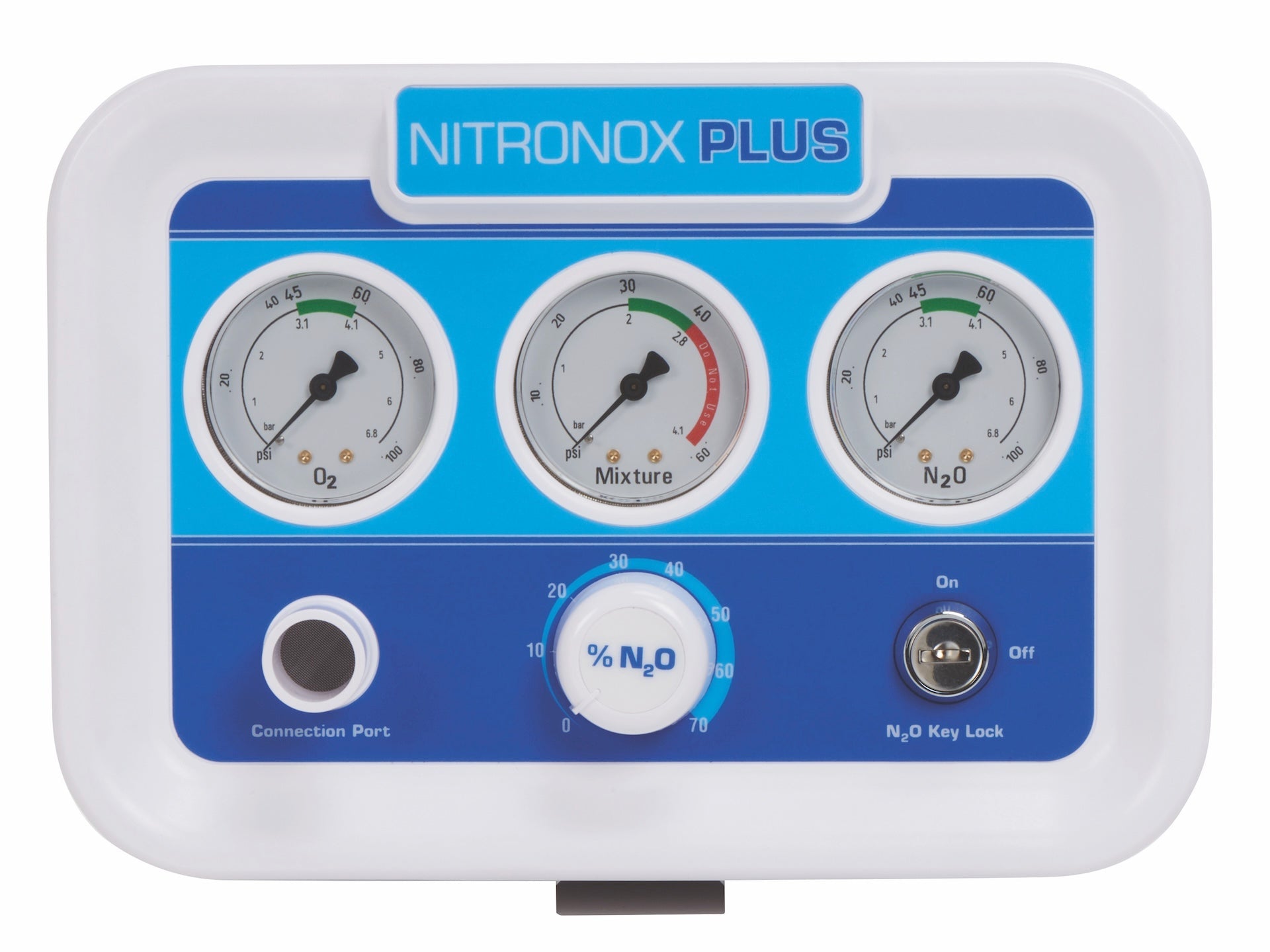
Nitrous oxide has an established role in office-based urology as an inhaled analgesic and anxiolytic, but the way it is administered — concentration, agent combinations, monitoring, scavenging, and how the practice charges for it — determines whether the encounter is minimal sedation with a straightforward workflow or moderate sedation with a full documentation burden. This guide walks urologists, office managers, and biomed staff through the clinical evidence, the American Society of Anesthesiologists (ASA) sedation classification, contraindications, occupational safety, and the operational and reimbursement framework for offering nitrous oxide analgesia in the modern urology office.
Clinical Evidence in Office Urology
The most current urology-specific synthesis is the 2020 Urology review by Gopalakrishna and colleagues, which analyzed 11 studies of nitrous oxide across ambulatory urologic procedures. The review documents use in flexible cystoscopy, transrectal ultrasound-guided prostate biopsy, ureteral stent placement, extracorporeal shockwave lithotripsy, and pediatric catheterization. The authors report significant improvements in peri-procedural pain and anxiety relative to alternative or no analgesia, with adverse effects described as rare and self-limited.
Procedure-specific evidence has continued to accumulate. A 2024 double-blind randomized trial published in the Journal of Urology by Escobar and colleagues enrolled 133 patients undergoing transrectal prostate biopsy and randomized them to patient-self-adjusted nitrous oxide (20–45%) versus oxygen, both in addition to routine periprostatic bupivacaine block. Patients in the nitrous oxide group reported significantly lower pain scores on the visual analog scale (p=0.026) and operating urologists rated procedure tolerance significantly better (p=0.03). The primary anxiety endpoint was not met, and complications were similarly low in both arms — an honest characterization of nitrous oxide as an effective pain adjunct rather than an anxiolytic panacea. A separate 2018 randomized trial by Cazarim and colleagues compared a 50:50 nitrous oxide–oxygen mixture against 100% oxygen in 84 prostate biopsy patients and reported markedly lower pain scores (VAS 2.52 vs 5.95, p<0.001) and higher satisfaction (8.14 vs 4.69, p<0.001) in the nitrous oxide group.
For flexible cystoscopy, the seminal RCT by Calleary and colleagues in the Journal of Urology randomized 61 men under age 55 to Entonox (50/50 nitrous oxide–oxygen) or air, both with 20 mL of 2% intraurethral lidocaine gel. Cystoscopy pain scores were significantly lower with Entonox (p<0.001), side effects were transient, and more patients in the air group indicated they would require additional analgesia or general anesthesia for a repeat procedure. A 2021 review in Contemporary Oncology by Łaszkiewicz and colleagues synthesized subsequent cystoscopy evidence and concluded that nitrous oxide provides a significant decrease in cystoscopy-related pain with a favorable side-effect profile.
The ASA Sedation Continuum — Where Nitrous Oxide Sits
Every operational and reimbursement decision that follows depends on the sedation classification. The ASA Statement on Continuum of Depth of Sedation, last amended October 23, 2024, defines Minimal Sedation (Anxiolysis) as "a drug-induced state during which patients respond normally to verbal commands. Although cognitive function and physical coordination may be impaired, airway reflexes, and ventilatory and cardiovascular functions are unaffected." Moderate Sedation/Analgesia — "conscious sedation" — is a depression of consciousness produced typically by titration of intravenous sedatives and/or analgesics during the procedure.
The foundational ASA Practice Guidelines for Sedation and Analgesia by Non-Anesthesiologists provide the operational boundary that matters most for a urology office: "Examples of minimal sedation include peripheral nerve blocks, local or topical anesthesia, and either (1) less than 50% nitrous oxide (N₂O) in oxygen with no other sedative or analgesic medications by any route…"
Two conditions are therefore required to keep an office nitrous oxide encounter in the minimal-sedation category: nitrous oxide concentration must not exceed 50%, and no other sedative or analgesic — including oral anxiolytics — may be administered by any route. Cross either boundary and the encounter becomes moderate sedation, which triggers the full ASA moderate-sedation protocol: independent trained observer, continuous pulse oximetry, blood pressure every five minutes, ASA classification documentation, and structured recovery scoring.
Contraindications and Patient Selection
Nitrous oxide diffuses into closed gas-containing spaces 30 times faster than nitrogen can diffuse out, which drives most of the contraindications. The current StatPearls monograph on nitrous oxide by Knuf and Maani states plainly that nitrous oxide is contraindicated in pneumothorax, small bowel obstruction, middle ear surgery, and retinal surgeries involving an intraocular gas bubble. Nitrous oxide also stimulates cerebral blood flow and increases intracranial pressure, making it a poor choice for patients with known intracranial hypertension.
Nitrous oxide inactivates methionine synthase by oxidizing the cobalt atom in vitamin B12, and StatPearls documents that recurrent exposure may lead to megaloblastic anemia with neurologic dysfunction — particularly in patients with unrecognized cobalamin deficiency (vegans, pernicious anemia, hereditary disorders of cobalamin, and folate metabolism). For the same reason, nitrous oxide use is not recommended in the first trimester of pregnancy. Severe cardiac disease is a relative caution because elevated homocysteine may compound cardiovascular risk.
A conservative office contraindication list for a urology practice should include: pneumothorax or recent pulmonary bleb disease, bowel obstruction, recent middle ear or retinal surgery with residual intraocular gas, known or suspected cobalamin/folate deficiency, first-trimester pregnancy, hemodynamic instability, and elevated intracranial pressure. Confirm every case against the device Instructions for Use (IFU) and the practice’s own sedation policy.
Occupational Safety and Scavenging
The NIOSH Pocket Guide to Chemical Hazards entry for nitrous oxide sets the recommended exposure limit at 25 ppm (46 mg/m³) TWA over the time exposed. OSHA has no permissible exposure limit, but the NIOSH REL is the operative occupational standard for waste anesthetic gas in United States healthcare facilities. Chronic occupational exposure without adequate scavenging has been linked to dyspnea, drowsiness, headache, and reproductive effects.
An office nitrous oxide program requires three interlocking controls: (1) an active scavenger system connected to the delivery device that captures exhaled and vented gas, (2) adequate room air exchange, and (3) periodic personal or area dosimetry to confirm the 25 ppm ceiling is not being exceeded in normal use. The scavenger and its consumables (circuits, canisters where applicable) must be maintained per the device IFU. Staff who administer or assist with nitrous oxide should be included in the practice’s occupational exposure monitoring program.
Reimbursement — Cash-Pay Comfort Service, Not a Billable Sedation Code
Because nitrous oxide at 50% or less in oxygen, self-administered, with no other sedative or analgesic, is minimal sedation by ASA definition, the moderate-sedation CPT codes 99151, 99152, and 99153 do not apply. Reporting them for a standard Nitronox encounter would be a coding error. The clearest urology-specific summary of the coverage position is by Jonathan Rubenstein, MD and Mark Painter, published in Urology Times in 2024: "Based on the definitions from the ASA and coverage rules for Medicare, the use of nitrous oxide for urology procedures is a noncovered service." No CPT or HCPCS code exists to report nitrous oxide administration for a urology procedure, and no revenue code applies on a professional (CMS-1500) claim.
The practical result is a much simpler workflow than a moderate-sedation program: the underlying procedure is reimbursed as usual under the current-year Medicare Physician Fee Schedule, and the nitrous oxide is offered as a cash-pay patient comfort service. There is no Advance Beneficiary Notice requirement (there is no covered service to notify the patient about), no prior authorization, no independent trained observer requirement at the minimal-sedation level, and no coding-compliance risk from an incorrectly reported sedation code. Practices set their own cash fee for the service and communicate it transparently at scheduling.
A urology office that combines nitrous oxide with any other sedative or analgesic — including oral midazolam or a periprostatic block with anything beyond local anesthetic — moves the encounter into moderate sedation. At that point 99152 becomes potentially reportable, but the practice must meet the full ASA moderate-sedation documentation standard: ASA classification, pre-sedation assessment, informed consent for sedation, medication and gas orders, start and stop times, concentration of nitrous oxide, continuous pulse oximetry with values documented every five minutes, blood pressure at baseline and every five minutes, response to treatment, recovery scoring, and adverse events. The 10-minute minimum intra-service time floor must also be met before 99151 or 99152 is reportable.
Standard Office Nitrous Oxide Workflow — Minimal Sedation Protocol
The workflow below assumes nitrous oxide at 50% or less in oxygen, self-administered with a demand-flow mask, no other sedative or analgesic by any route, and standard-of-care local anesthesia for the underlying procedure. Confirm every step against the device IFU and the practice’s own sedation policy.
- Pre-procedure screening. Review the contraindication list. Confirm no recent pulmonary, middle ear, or retinal surgery; no bowel obstruction; no known cobalamin deficiency; no first-trimester pregnancy; no acute hemodynamic instability.
- Consent. Discuss the nature of nitrous oxide analgesia (rapid onset, rapid offset, patient-controlled), expected side effects (transient nausea, dizziness, euphoria), and the cash-pay nature of the service. Document consent in the chart.
- Baseline vitals. Record heart rate, blood pressure, and oxygen saturation before mask application. Continuous monitoring is not required at the minimal-sedation level, but a baseline anchors any later assessment.
- Deliver local anesthesia per procedure standard. Lidocaine gel for cystoscopy, periprostatic block for transrectal biopsy, local infiltration for vasectomy, and so on. Nitrous oxide supplements — it does not replace — the standard local.
- Initiate nitrous oxide. Fit the demand-flow mask, confirm seal, and instruct the patient to breathe normally through the mask. Onset is within one to two minutes. The patient self-holds the mask; if the patient drops the mask, delivery stops — an inherent safety feature of the demand-flow system.
- Perform the procedure. Maintain verbal contact with the patient throughout — a patient who cannot respond appropriately to verbal commands has crossed out of the minimal-sedation range and the workflow shifts to a moderate-sedation protocol.
- Discontinue nitrous oxide and administer 100% oxygen. Per StatPearls, "100% oxygen administration should follow nitrous oxide cessation" to prevent diffusion hypoxia. A three-to-five-minute period of 100% oxygen after mask discontinuation is standard.
- Post-procedure assessment. Confirm return to baseline mentation. Because minimal sedation preserves airway reflexes and cardiovascular function, extended recovery monitoring is not required, and the patient may typically leave without a driver — but confirm this against the practice’s own sedation policy and local regulations.
- Document. Record the indication, contraindication screening, consent, local anesthetic used, nitrous oxide concentration (kept at or below 50%), start and stop times, absence of other sedatives or analgesics, patient tolerance, and any adverse events.
Nitronox Plus Device Fit
The Nitronox Plus system is FDA 510(k)-cleared for spontaneously breathing patients requiring analgesia and is available in fixed 50/50 and adjustable configurations, with adult and pediatric masks, breathing circuits, and a dedicated scavenger. The 50/50 fixed configuration is the simplest option for maintaining the minimal-sedation ≤50% ceiling — the device cannot deliver a higher nitrous oxide concentration. The adjustable configuration allows patient-titrated concentrations within a defined range, which was the delivery model in the Escobar 2024 prostate biopsy trial. Every clinical setting decision should reference the current device IFU rather than a general specification sheet. The pain and anxiety management collection lists the current Nitronox systems, accessories, and scavengers available for urology practices.
Quick-Reference Card — Minimal vs Moderate Sedation Boundaries
| Nitrous Oxide Sedation Classification — Office Urology | |
|---|---|
| Element | Threshold |
| Nitrous oxide concentration | ≤50% N₂O in O₂ for minimal sedation; >50% shifts to moderate |
| Concurrent sedatives or analgesics | None (any route) for minimal sedation; any addition shifts to moderate |
| Delivery | Patient self-administered demand-flow mask |
| Local anesthesia | Compatible with minimal-sedation classification per ASA |
| Continuous pulse oximetry required | Not required at minimal-sedation level; required at moderate |
| Independent trained observer required | Not required at minimal-sedation level; required at moderate |
| Reportable CPT sedation code | None (noncovered per Urology Times 2024) at minimal; 99151–99153 potentially applicable at moderate |
| Occupational exposure limit | NIOSH REL 25 ppm TWA — applies at every level, always requires scavenging |
| Post-cessation oxygen | 100% O₂ for 3–5 minutes to prevent diffusion hypoxia |
Frequently Asked Questions
Is nitrous oxide the same as "conscious sedation" or "twilight" anesthesia?
No. Nitrous oxide at 50% or less in oxygen with no other sedative or analgesic is classified as minimal sedation (anxiolysis) by the ASA. Conscious sedation — the older term for moderate sedation — involves a drug-induced depression of consciousness produced by titrated intravenous sedatives, which is a different clinical and regulatory category. The distinction determines monitoring requirements, staffing, documentation, and billing.
Do we need an anesthesiologist or CRNA to offer office nitrous oxide?
Not at the minimal-sedation level as defined by the ASA framework, provided the practice keeps nitrous oxide concentration at 50% or less and combines it only with local or topical anesthesia. State-level regulations may impose additional requirements, so confirm with the state medical board and, where applicable, the state dental or anesthesia rules that also cover office N₂O.
Can we bill Medicare or commercial insurance for the nitrous oxide administration?
No. Per Rubenstein and Painter in Urology Times, "the use of nitrous oxide for urology procedures is a noncovered service" under ASA definitions and Medicare coverage rules. No CPT or HCPCS code applies to office nitrous oxide administration for a urology procedure, and most commercial payers follow Medicare’s noncovered posture. Practices typically offer the service as cash-pay.
What CPT sedation codes apply if we exceed 50% or add an oral anxiolytic?
Crossing either boundary shifts the encounter to moderate sedation, at which point CPT 99151, 99152, and 99153 (moderate sedation performed by the same physician doing the procedure) become potentially reportable — but only if the full ASA moderate-sedation documentation standard is met, an independent trained observer is present, and the 10-minute minimum intra-service time is documented. This is a materially heavier workflow than minimal-sedation nitrous oxide.
What are the most important contraindications to remember?
The closed-space contraindications — pneumothorax, small bowel obstruction, recent middle ear surgery, and retinal surgery with intraocular gas — plus known cobalamin/folate deficiency and first-trimester pregnancy. See the StatPearls monograph for the full list and confirm against the device IFU.
How does the practice protect staff from occupational nitrous oxide exposure?
Three overlapping controls: an active scavenger connected to the delivery device, adequate room air exchange, and periodic dosimetry to confirm the NIOSH 25 ppm REL is not exceeded. Include nitrous oxide administrators in the practice’s occupational exposure monitoring program.
Where does nitrous oxide fit relative to standard local anesthesia?
Nitrous oxide supplements standard local anesthesia — it does not replace it. Intraurethral lidocaine gel for cystoscopy, periprostatic block for transrectal prostate biopsy, and local infiltration for vasectomy remain the primary anesthetic modality. Nitrous oxide is an anxiolytic-analgesic adjunct that improves patient tolerance of the procedure, and the evidence supports this framing across urology. See the companion article on managing ureteral stent discomfort for the analgesic framework applied to indwelling-stent patients.
Related in This Series
This pillar is the framework overview. The following articles cover specific applications and the reimbursement structure:
- Structuring nitrous oxide as a cash-pay comfort service — Good Faith Estimate framework, consent, and pricing structure per the No Surprises Act.
- Nitrous oxide for office flexible cystoscopy — application to diagnostic and surveillance cystoscopy.
- Nitrous oxide for office prostate biopsy (2026 CPT) — includes the 2026 CPT 55700 → 55705–55715 restructuring.
- Nitrous oxide for office ureteral stent placement and removal — evidence from the Doersch 2018/2019 case series and OR-vs-office comparison.
- Nitrous oxide as a comfort adjunct for office vasectomy — AUA-permitted adjunct framing.
- Nitrous oxide as a comfort adjunct for office BPH therapies (Rezūm and UroLift) — additive and substitutive patterns for MIST.
This article is for informational purposes for healthcare professionals. It does not constitute medical advice or replace clinical judgment. Always follow your institution’s protocols, state regulations, and the manufacturer’s instructions for use. Sedation classification, patient selection, and reimbursement determinations require case-by-case judgment by the treating clinician.