
Ureteral stent placement and stent removal are two of the highest-volume cystoscopic procedures in most urology practices, and both are strong candidates to move from the operating room to the office procedure suite. The single largest published series of office-based ureteral stenting was performed with nitrous oxide analgesia and reported outcomes comparable to or better than the operating room, with no anesthetic complications across 565 patients. This guide walks urologists through the current evidence, the 2026 CPT reimbursement framework for stent insertion and removal, patient selection, and workflow for adding nitrous oxide as a cash-pay comfort service to a stent program.
Why Nitrous Oxide Fits Office Stent Procedures
Ureteral stent placement is a procedure with two distinct pain windows: the passage of the flexible cystoscope into the bladder and the manipulation of the guidewire and stent through the ureteral orifice. Stent removal in the office is briefer but frequently anxiety-driven, particularly for patients who had their stent placed under general anesthesia and have no personal reference for what an awake procedure feels like. Nitrous oxide fits both patterns because its onset is one to two minutes, its offset is a similar window after mask discontinuation, and it stays inside the American Society of Anesthesiologists (ASA) minimal-sedation category at 50 percent or less in oxygen with no other sedative. Patients drive themselves home. The full framework across urology procedures is covered in the pillar guide to office urology nitrous oxide analgesia.
Evidence Base for Stent Procedures Specifically
The largest and most directly relevant evidence comes from a two-part series by Doersch and colleagues at Baylor Scott and White. The initial feasibility report, Doersch 2018 in the Canadian Journal of Urology, was a case series of 565 patients undergoing ureteral stent placement in an office procedure suite with nitrous oxide plus local anesthesia. Complications occurred in 4.1 percent of procedures, unplanned admissions in 2.5 percent, and stent placement failures in 1.0 percent. Only two of the 565 patients had their procedures stopped due to discomfort, and no anesthetic complications of any kind were encountered. The authors described the report as the first published use of nitrous oxide as an office analgesic for ureteral stenting.
The follow-on study, Doersch 2019 in Urology, extended the same office cohort of 565 patients and added a comparison group of 179 stent placements performed in the operating room during the same period, typically under general anesthesia. The complication rate was 4.1 percent in the office group and 7.8 percent in the operating room group. Unplanned hospital admissions occurred in 3.0 percent of office procedures and 9.5 percent of operating room procedures. Stent placement failures were 1.1 percent in the office and 0.56 percent in the operating room, a small absolute difference. Procedure time was ten minutes in the office and twelve minutes in the operating room (P less than 0.01). On multivariable analysis, the setting (office versus operating room) was not a predictor of complications (P equals 0.99). The authors concluded that office ureteral stenting with nitrous oxide analgesia produces excellent outcomes, shorter procedure time, and no meaningful difference in complication rates compared with the operating room.
These two publications sit within the broader Gopalakrishna 2020 Urology review of nitrous oxide in office urology, which identified stent placement and removal as one of the emerging indications with the strongest early data. Adjacent economic evidence for office-based stenting more generally is available in Connelly 2023 in the American Journal of Clinical and Experimental Urology, which framed the office setting as safe and cost-effective compared with the operating room across a separate institutional cohort.
What the evidence does not yet include is a randomized controlled trial of nitrous oxide versus local anesthesia alone for stent placement or removal. The published data is observational and retrospective. Practices adopting office stenting with nitrous oxide should frame the intervention accordingly: strong observational safety data from a single large series, no head-to-head RCT.
Patient Selection
Not every stent candidate is an office candidate, and not every office candidate is a nitrous oxide candidate. Two selection layers apply.
Office versus operating room. Patients with a stable clinical picture, no active urosepsis, no complex anatomy requiring fluoroscopic guidance beyond office capability, and no known ureteral stricture at the level of the ureteral orifice are reasonable office candidates. Patients with active sepsis, altered mental status, uncontrolled coagulopathy, or difficult anatomy remain operating room cases.
Nitrous oxide eligibility. Exclusions follow the standard Nitronox Plus device instructions for use (IFU) and the ASA framework for minimal sedation: no pneumothorax or bowel obstruction, no recent middle ear or intraocular surgery, no vitamin B12 deficiency for prolonged or repeat exposures, no first-trimester pregnancy, and no chronic opioid or benzodiazepine use that would push a patient beyond minimal sedation when combined with N₂O. Patients on chronic supplemental oxygen or with severe COPD warrant individualized review. The full eligibility checklist appears in the pillar guide.
Room Setup and Equipment
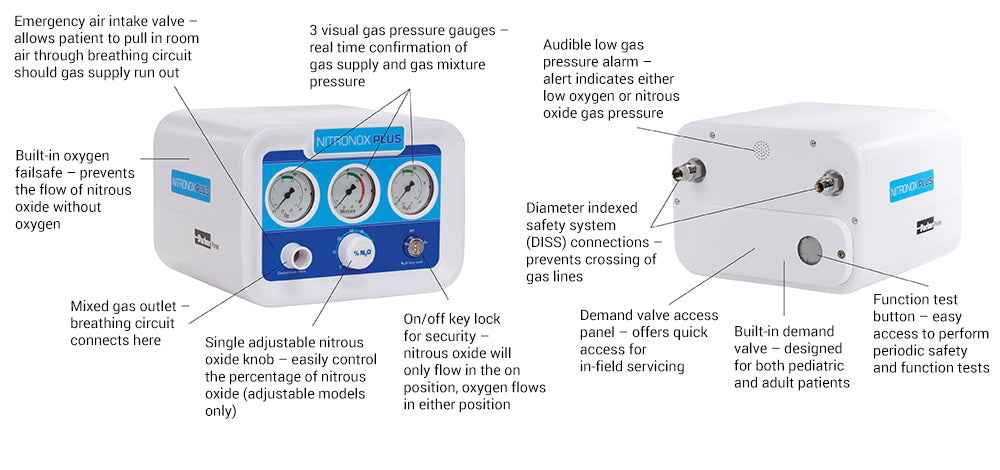
An office stent program shares its room with the flexible cystoscopy program and adds only the stent-specific inventory. Core equipment: a flexible cystoscope with working channel, guidewires (typically a hydrophilic-tipped 0.038-inch wire), the appropriate double-J stents in the required lengths and diameters, a stent introducer or pusher, a lidocaine 2 percent jelly urethral instillation setup, and the Nitronox Plus delivery system with single-use patient breathing circuit and scavenging attached to the room ventilation exhaust. The cystoscopic hardware for the setup is described in the Minerva cystoscope resource page, and the analgesia hardware sits within the pain and anxiety management collection. Fluoroscopy availability is optional for straightforward cases but is required for programs that include exchanges over guidewire or difficult placements.
Procedural Workflow
The following stepwise workflow reflects the office pattern used in the Doersch series and matches the standard flexible cystoscopy workflow with stent-specific additions.
- Consent and eligibility confirmation. Confirm indication, review NPO status if institutional policy requires it, screen for the exclusions above, and set expectations that the patient will drive home.
- Room preparation. Position the patient in lithotomy, prep and drape, and place the pulse oximeter. Have the guidewire, stent, and stent pusher opened on the sterile field before starting.
- Baseline vitals. Record baseline pulse and oxygen saturation. No IV access is required for minimal sedation with nitrous oxide.
- Urethral local anesthetic. Instill 10 to 20 mL of 2 percent lidocaine jelly and hold with a penile clamp for two to three minutes.
- Initiate nitrous oxide. The patient self-administers the mask. Start at a lower nitrous oxide concentration and titrate to comfort within the device-labeled range at or below 50 percent N₂O in oxygen. Confirm the scavenging system is capturing exhaled gas at the mask before proceeding.
- Cystoscope insertion and ureteral orifice identification. Advance the flexible cystoscope into the bladder, identify the target orifice, and pass the guidewire.
- Guidewire advancement and stent placement. Advance the wire to the renal pelvis using fluoroscopy if available. Pass the stent over the wire and deploy the proximal and distal coils in the standard fashion.
- Stent removal (alternative endpoint). For a stent removal procedure, grasp the distal coil with the flexible cystoscope grasper or a snare, confirm intact removal, and inspect the bladder.
- Nitrous oxide discontinuation and recovery. Discontinue N₂O delivery, keep the patient on 100 percent oxygen for one to two minutes to accelerate washout, then remove the mask. Recheck pulse and oxygen saturation.
- Discharge. Confirm the patient is alert, oriented, ambulatory, and asymptomatic. Provide written stent care or post-removal instructions. Patients drive themselves home.
Reimbursement — 2026 CPT Framework
Three CPT codes cover the vast majority of office stent work, and each is a separate billable event distinct from any nitrous oxide comfort service the practice may offer. All fee schedule values below are the 2026 CMS national average from the CMS Physician Fee Schedule search tool and are shown as non-facility (office) and facility (ASC or hospital) rates. Local adjustments and payer contracts vary.
CPT 52332 — Cystourethroscopy with Ureteral Stent Insertion
Describes cystourethroscopy with insertion of an indwelling ureteral stent (for example, Gibbons or double-J type) and is the primary code for the placement procedures described above. CY2026 CMS national average: $372.75 non-facility, $139.62 facility. The differential reflects the office practice expense for owning and operating the cystoscopy and analgesia infrastructure.
CPT 52310 — Cystourethroscopy with Removal of Foreign Body, Simple
Describes cystourethroscopy with the simple removal of a foreign body from the bladder or urethra, including a straightforward indwelling stent removal. CY2026 CMS national average: $298.60 non-facility, $134.61 facility.
CPT 52315 — Cystourethroscopy with Removal, Complicated
Describes cystourethroscopy with complicated foreign body removal, which applies to encrusted or fragmented stents, dislodged stents, or removals requiring adjunctive maneuvers beyond simple grasping. CY2026 CMS national average: $457.59 non-facility, $242.49 facility. Complexity documentation must support the code selection.
Nitrous Oxide — Cash-Pay Only in Adult Urology
No CPT code exists for nitrous oxide gas administration in adult urology. The dental HCPCS code D9230 is dental only and is not billable to Medicare or medical payers for urologic procedures. As documented in a 2024 Urology Times reimbursement column by Rubenstein and Painter, and per the ASA Continuum of Depth of Sedation, patient-self-administered nitrous oxide at 50 percent or less N₂O in oxygen with no other sedative is minimal sedation and is not eligible for the moderate-sedation CPT codes 99151 through 99157. The Rubenstein and Painter column states the operational conclusion directly: for urology procedures, nitrous oxide use is a noncovered service. The service is therefore structured as a cash-pay patient comfort offering with a Good Faith Estimate delivered per the No Surprises Act framework detailed in the cash-pay nitrous oxide comfort service guide.
Bladder Discomfort After Stent Placement — Framing for Patients
A meaningful minority of stent patients experience post-procedure bladder discomfort driven by the coil resting on the trigone. This is separate from the procedural pain the nitrous oxide addresses. Patient counseling should distinguish clearly between procedural comfort (managed with N₂O plus local) and post-procedure indwelling-stent symptoms (managed with alpha blockers, anticholinergics, and time). Practices that fail to draw this line find that patients conflate the two and blame the anesthesia for symptoms that would have occurred regardless of anesthetic choice.
Documentation Requirements
Every office stent procedure that includes nitrous oxide requires documentation of four elements independent of the procedure code itself: nitrous oxide eligibility screen with exclusions verified, informed consent for the comfort service (separate from procedural consent), start and stop times of gas delivery, and peak N₂O concentration reached. A brief post-procedure note that the patient tolerated the procedure, returned to baseline within the expected offset window, and was discharged ambulatory closes the record. This documentation supports both quality review and any future audit of the cash-pay comfort service.
Quick-Reference Card — Office Stent Nitrous Oxide Program
| Office Stent Program — Nitrous Oxide Quick Reference | |
|---|---|
| Category | Value |
| Best-evidence anchor | Doersch 2019, Urology (retrospective, n=565 office vs 179 OR) |
| Complication rate (office) | 4.1 percent |
| Complication rate (OR) | 7.8 percent |
| Unplanned admissions (office vs OR) | 3.0 vs 9.5 percent |
| Anesthetic complications reported | None across 565 patients |
| Procedure time (office vs OR) | 10 vs 12 minutes (P less than 0.01) |
| N₂O concentration | Titrate up to 50 percent in oxygen; patient-self-administered |
| ASA sedation level | Minimal (at ≤50 percent N₂O with no other sedative) |
| Driver required | No |
| CPT 52332 (insertion) — 2026 CMS | $372.75 office / $139.62 facility |
| CPT 52310 (simple removal) — 2026 CMS | $298.60 office / $134.61 facility |
| CPT 52315 (complicated removal) — 2026 CMS | $457.59 office / $242.49 facility |
| Nitrous oxide reimbursement | Cash-pay; noncovered by medical payers |
| Consent | Separate procedural + comfort-service consent |
| Good Faith Estimate | Required per No Surprises Act |
Frequently Asked Questions
Is nitrous oxide safe for elderly stent patients?
Age alone is not an exclusion. The Doersch series included a broad age range, and no anesthetic complications occurred in any patient. Standard exclusions (pneumothorax, bowel obstruction, recent middle ear or intraocular surgery, B12 deficiency for prolonged exposures, first-trimester pregnancy, and additive-sedation risk) apply regardless of age. Elderly patients on chronic opioids or benzodiazepines warrant individualized review.
Can nitrous oxide be used for stent exchange in the office?
Yes, the same eligibility criteria apply. Practices without fluoroscopy in the room should reserve exchanges for cases where the existing stent is well-positioned and the exchange can be performed over a guidewire without imaging.
Does 52332 include imaging?
52332 does not include separately reportable fluoroscopy in most payer contracts, and the current NCCI edits bundle common imaging codes reported with cystoscopic stent placement. Verify against the payer-specific edit set for each contract.
How is complicated (52315) versus simple (52310) removal decided?
52315 applies when the removal requires maneuvers beyond simple grasping of the coil — for example, an encrusted stent requiring lithotripsy, a fragmented stent requiring additional retrieval passes, or a dislodged stent requiring flexible cystoscopic navigation into the ureter. The medical record must document the complexity that justifies the code.
Can a patient elect out of nitrous oxide mid-procedure?
Yes, and this is a defining safety feature. The patient controls the mask. Discontinuation causes rapid offset within one to two minutes, and the procedure can be completed with local anesthesia alone or paused if the patient prefers to stop entirely.
Where does this fit in the Minerva urology cluster?
This article is the stent-specific installment. The framework, exclusions, and evidence overview live in the pillar guide. The reimbursement structure for the cash-pay comfort service lives in the cash-pay article. The general cystoscopy workflow, which applies to non-stent flexible cystoscopy, has its own dedicated article.
This article is for informational purposes for healthcare professionals. It does not constitute medical advice or replace clinical judgment. Always follow your institution’s protocols and the manufacturer’s instructions for use. The published evidence for nitrous oxide in office ureteral stenting is observational; no randomized controlled trial has been published as of this writing.