
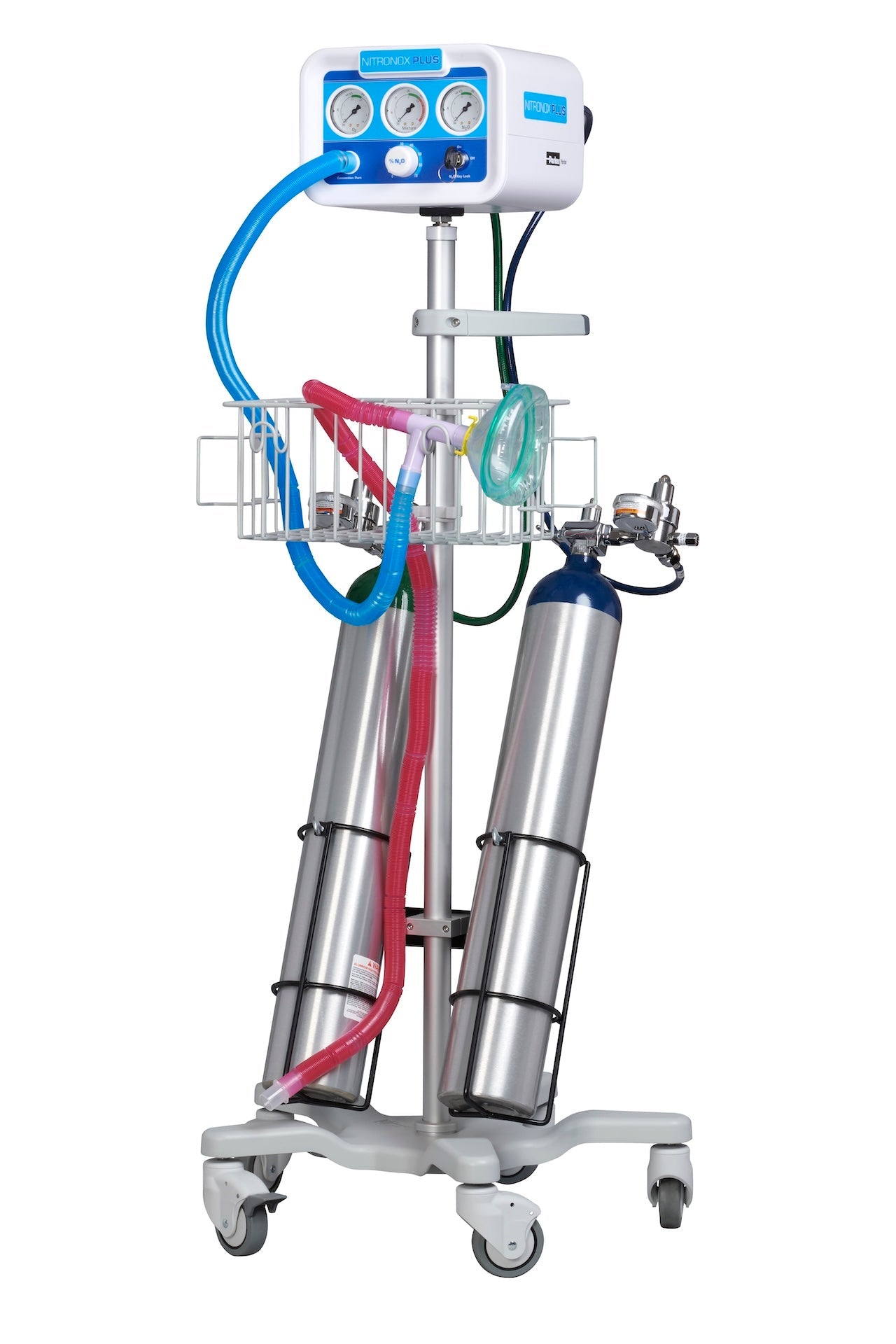
Offering nitrous oxide analgesia in a urology office runs on a very different administrative track than the moderate-sedation programs many practices are used to. Because nitrous oxide at 50% or less in oxygen, self-administered, with no other sedative or analgesic is classified as minimal sedation by the American Society of Anesthesiologists (ASA), there is no billable CPT code and no covered service to bill Medicare or most commercial payers. That makes it a cash-pay patient comfort service — simpler on the coding side, but with its own regulatory and financial-policy requirements the practice must build. This guide walks practice managers, office managers, and urologists through the setup: fee philosophy, Good Faith Estimate compliance under the No Surprises Act, patient-facing consent, staff roles, scheduling integration, and the boundaries that would push the encounter into moderate sedation.
Why the Cash-Pay Model — the Medicare Noncovered Posture
The starting point is a plain statement from Jonathan Rubenstein, MD and Mark Painter, published in Urology Times in 2024: “Based on the definitions from the ASA and coverage rules for Medicare, the use of nitrous oxide for urology procedures is a noncovered service.” No CPT or HCPCS code exists to report office nitrous oxide administration for a urology procedure. There is no covered-service determination to appeal, no Advance Beneficiary Notice to sign (because there is no Medicare-covered service in question), and no prior authorization to pursue. Most commercial payers follow the Medicare posture.
The practical consequence is that the underlying procedure — cystoscopy, transrectal prostate biopsy, stent placement — is billed as usual under the Medicare Physician Fee Schedule, while the nitrous oxide is offered on a cash basis. That framing eliminates the coding-compliance risk of an incorrectly reported sedation code, removes the moderate-sedation documentation burden, and keeps the two revenue streams separate. For the full clinical and operational framework, see the pillar guide to office urology nitrous oxide analgesia.
Regulatory Foundation — the ASA Minimal-Sedation Boundary
The cash-pay simplicity depends entirely on staying inside the ASA minimal-sedation category. The ASA Statement on Continuum of Depth of Sedation, last amended October 23, 2024, defines minimal sedation (anxiolysis) as a drug-induced state during which patients respond normally to verbal commands, with airway reflexes, ventilatory function, and cardiovascular function unaffected. The ASA Practice Guidelines for Sedation and Analgesia by Non-Anesthesiologists operationalize this for office nitrous oxide: minimal sedation includes “less than 50% nitrous oxide (N₂O) in oxygen with no other sedative or analgesic medications by any route.”
The two boundary conditions the practice must maintain are: nitrous oxide concentration at or below 50%, and no other sedative or analgesic — including oral anxiolytics like midazolam — administered by any route in the same encounter. Local anesthesia (intraurethral lidocaine gel, periprostatic block, local infiltration) is compatible with the minimal-sedation classification. Crossing either boundary shifts the encounter to moderate sedation and blows up the cash-pay simplicity by triggering the full moderate-sedation documentation standard and potentially reportable CPT codes 99151–99153.
Financial Policy — Fee Philosophy and Disclosure
Every practice sets its own fee for a cash-pay comfort service. The fee should reflect the direct cost of the nitrous oxide (gas plus the disposable circuit and mask), a share of the amortized cost of the delivery device and scavenger, staff time above the standard procedure time, and the practice’s cash-pay margin philosophy. There is no CMS benchmark for this service because there is no CMS-covered analog. Practices should avoid benchmarking against dental or obstetric cash-pay N₂O pricing without adjusting for the different procedure context and staffing.
A minimum financial-policy set includes: a written fee, a written statement of what the fee does and does not include (it does not include the underlying procedure, which is billed to insurance), a refund and cancellation policy, disclosure of the fee at scheduling and at check-in, and a signed acknowledgment at the point of service. All of that is separate from — and in addition to — the Good Faith Estimate obligation covered below. Devices, disposables, and scavengers are listed in the pain and anxiety management collection.
Good Faith Estimate Compliance Under the No Surprises Act
Cash-pay is not consequence-free. The No Surprises Act, effective January 1, 2022, requires providers to give uninsured and self-pay patients a written Good Faith Estimate (GFE) of expected charges when they schedule an item or service or when they ask for an estimate. This is the one substantive compliance obligation a cash-pay N₂O program takes on, and it is a federal requirement — not an optional patient-communication nicety.
Who is entitled to a GFE
Per the CMS GFE Decision Tree for Providers, the No Surprises Act requires GFEs for consumers “who do not have health coverage or those who lack coverage for a particular item or service” and consumers “who have certain types of health coverage but do not intend to use it (also known as 'self-pay' individuals).” The federal-program carve-out is important: patients enrolled in Medicare, Medicaid, TRICARE, or FEHB “are not eligible to receive a good faith estimate, even if they do not plan to use that coverage, as there are other surprise billing protections under these programs.” A Medicare beneficiary who wants to pay cash for the nitrous oxide comfort service therefore does not receive a GFE for that piece — but a commercially insured patient whose plan will not cover the comfort service, and who elects to pay cash for it, does receive one.
Timing rules
Two thresholds drive the timing, both from the CMS Good Faith Estimate fact sheet:
- Scheduled at least 10 business days before the service date, or upon request only: GFE must be provided no later than 3 business days after scheduling or the request.
- Scheduled 3 to 9 business days before the service date: GFE must be provided no later than 1 business day after scheduling.
- Scheduled fewer than 3 business days before the service date: a GFE is not required.
Verbal estimates given by phone or in person are permitted, but the CMS decision tree requires the practice to follow up with a written GFE “in the individual’s preferred form of written communication.” If the scope of the estimate changes materially before the service date, the practice must issue a new GFE at least one business day before the scheduled visit.
What the GFE must include
Per CMS GFE FAQs Part 4 and 45 CFR 149.610, the GFE must include a description of the primary item or service, an itemized list of items or services reasonably expected to be furnished in conjunction with it, applicable diagnosis codes, expected service codes, and expected charges associated with each item — with charges reflecting any applicable discounts. Identifying information required in the estimate includes the name, NPI, and TIN of each provider or facility, plus the state and office location where the services will be furnished. The CMS sample GFE form lays out the exact field structure practices can adopt.
Handling the nitrous oxide line item specifically
Because there is no CPT or HCPCS code that describes office nitrous oxide administration for a urology procedure, the nitrous oxide line item on the GFE cannot carry a standard service code. Best practice is to describe the service by name (“Patient-administered nitrous oxide analgesia for office urologic procedure — cash pay”) with the practice’s cash fee and to leave the service-code column marked “N/A — non-covered comfort service.” The underlying procedure — cystoscopy, prostate biopsy, stent management — appears as a separate line item with its own CPT code, and its expected charges reflect the practice’s usual and customary rate for a self-pay patient (which may or may not be the same as the Medicare allowed amount, depending on the practice’s cash-pay pricing policy).
Dispute rights and anti-retaliation
The CMS fact sheet states plainly that “if the billed amount is $400 or more above the good faith estimate, you may be eligible to dispute the bill.” Per CMS FAQs Part 4, the patient has 120 calendar days from the original bill date to initiate the Patient-Provider Dispute Resolution process. Anti-retaliation language is federal: a provider or facility cannot move the disputed bill to collections, threaten to do so, or refuse ongoing care in response to the patient’s dispute filing. Practices should train their billing and front-office staff on these rights.
Patient-Facing Consent — Separate From Clinical Consent
Consent for the nitrous oxide service should be a distinct document from the procedure consent. The two documents cover different risks and different decisions. The clinical consent for the underlying procedure discusses procedure-specific risks, benefits, and alternatives. The nitrous oxide consent should cover: the nature of nitrous oxide analgesia (rapid onset, rapid offset, patient-self-administered), the expected side effects (transient nausea, dizziness, mild euphoria), the material contraindications the practice screens for, the fact that the service is not covered by insurance and is offered cash-pay, the fee, the refund and cancellation policy, and the patient’s right to decline or stop the service at any time. Signed at check-in, before the mask is applied.
The consent should be a page. Longer documents get read less. A shorter document that is explicit about the cash-pay nature of the service and the material clinical caveats is more defensible than a long boilerplate that a stressed patient signs without reading.
Staff Roles and Training
At the minimal-sedation level, the ASA framework does not require an independent trained observer or continuous pulse oximetry. Practical staffing is typically: the urologist performs the procedure, a medical assistant or nurse fits the mask and confirms delivery, and a front-office staff member handles the cash-pay logistics (GFE, consent, payment collection). One person may hold multiple roles in a small practice — the requirement is that the person administering the mask has been trained on the device, the emergency protocols, and the practice’s contraindication checklist.
Baseline training for any staff involved in nitrous oxide administration: device operation per the current Instructions for Use, contraindication screening, emergency response including diffusion hypoxia and 100% oxygen recovery, occupational exposure awareness per the NIOSH 25 ppm recommended exposure limit, and documentation. Refresh annually and whenever the device or protocol changes. The Nitronox Plus nitrous oxide system is FDA 510(k)-cleared for spontaneously breathing patients; the device IFU is the authoritative source for training content.
Scheduling and Workflow Integration
Nitrous oxide adds five to ten minutes to a procedure visit — one to two minutes of mask fitting and onset before the procedure, and three to five minutes of 100% oxygen recovery afterward. Practices commonly block a longer visit slot rather than trying to compress the timing. The front desk needs a way to flag the request at scheduling so the room, the device, and the disposable circuit are prepared before the patient arrives. If the scheduling flag also drives the GFE workflow — for example, an EHR task fires as soon as a self-pay patient elects the service — the practice avoids the trailing-compliance risk of forgetting to issue the estimate. A related cash-pay analgesic framework appears in the guide to managing ureteral stent discomfort.
Compliance Boundaries — What Blows Up the Cash-Pay Simplicity
Two boundaries define the cash-pay minimal-sedation model, and crossing either one changes the workflow materially. First, nitrous oxide concentration above 50% shifts the encounter to moderate sedation. Second, adding any other sedative or analgesic by any route — an oral benzodiazepine at check-in, an IV sedative, or an intramuscular narcotic — also shifts it to moderate sedation. In either case, CPT codes 99151 and 99152 potentially become reportable, but the practice must simultaneously meet the ASA moderate-sedation documentation standard: independent trained observer, continuous pulse oximetry, blood pressure every five minutes, ASA classification, pre-sedation assessment, recovery scoring, and adverse-event documentation.
Practices should not treat CPT 99152 as a “just in case” code. Reporting a moderate-sedation code without meeting the documentation standard is a coding-compliance risk. Reporting one for a standard Nitronox encounter at 50% or less with no other sedative is a coding error because the encounter is not moderate sedation.
Quick-Reference Card — Cash-Pay N₂O Program Elements
| Cash-Pay Nitrous Oxide Comfort Service — Program Elements | |
|---|---|
| Element | Requirement or best practice |
| Sedation classification | Minimal sedation per ASA — nitrous oxide ≤50% with no other sedative or analgesic by any route |
| CPT code for the nitrous oxide service | None — noncovered service per Urology Times 2024 |
| Advance Beneficiary Notice (ABN) | Not applicable — no Medicare-covered service to notify about |
| Fee | Set by the practice; no CMS benchmark |
| Good Faith Estimate (self-pay commercial patients) | Required per No Surprises Act; timing 1 or 3 business days depending on scheduling window |
| Good Faith Estimate (Medicare/Medicaid/TRICARE/FEHB patients) | Not required — federal-program carve-out |
| Patient-facing consent | Separate from procedure consent; signed at check-in before mask fit |
| Independent trained observer | Not required at minimal-sedation level |
| Continuous pulse oximetry | Not required at minimal-sedation level; baseline vitals recommended |
| NIOSH 25 ppm REL | Applies at every level; scavenging and periodic dosimetry required |
| Post-cessation oxygen | 100% O₂ for 3–5 minutes to prevent diffusion hypoxia |
| Documentation floor | Indication, contraindication screen, consent, local anesthetic used, N₂O concentration, start/stop times, absence of other sedatives, tolerance, adverse events |
Frequently Asked Questions
Do we need to give a Good Faith Estimate to a Medicare patient paying cash for the comfort service?
No. Per the CMS GFE Decision Tree, individuals enrolled in Medicare, Medicaid, TRICARE, or FEHB are not eligible to receive a GFE, even if they do not plan to use that coverage. A commercially insured patient who elects cash for the comfort service does receive one.
Can we advertise a fixed cash price for the service?
Yes, provided the fee is transparent, consistent, and disclosed at scheduling and again at check-in. A fixed cash fee also simplifies the GFE. State-level cash-pricing transparency rules may add requirements above the federal floor.
How do we handle a bill that exceeds the GFE by less than $400?
The $400 threshold triggers the federal Patient-Provider Dispute Resolution process. Below that, patients have no federal dispute right but can still ask the practice to review or negotiate the bill. Keep the ultimate charge as close to the GFE as possible.
How long do we need to retain provider-side GFE records?
The CMS provider guidance does not specify a duration. Retain per the practice’s standard medical-record retention policy and applicable state law; confirm with the practice’s compliance counsel.
What happens if we add oral midazolam or an IV sedative?
The encounter shifts from minimal to moderate sedation. CPT 99151 or 99152 may become reportable, but only if the full ASA moderate-sedation documentation standard is met and an independent trained observer is present. The cash-pay workflow simplicity is lost at that point.
Related in This Series
This cash-pay framework applies across all office urology procedures where nitrous oxide is offered as an optional comfort adjunct:
- Nitrous oxide analgesia in office urology (pillar) — framework, ASA sedation levels, and general safety profile.
- Nitrous oxide for office flexible cystoscopy.
- Nitrous oxide for office prostate biopsy (2026 CPT).
- Nitrous oxide for office ureteral stent placement and removal.
- Nitrous oxide as a comfort adjunct for office vasectomy.
- Nitrous oxide as a comfort adjunct for office BPH therapies (Rezūm and UroLift).
This article is for informational purposes for healthcare professionals and practice managers. It does not constitute legal, coding, or compliance advice. Federal and state regulations change; confirm current requirements with the practice’s compliance counsel and the applicable state medical board. Always follow your institution’s protocols, state regulations, and the manufacturer’s instructions for use for any device or medication referenced.