
Water vapor thermal therapy (Rezūm) and prostatic urethral lift (UroLift) are the two office-based minimally invasive surgical therapies (MIST) most widely adopted for benign prostatic hyperplasia (BPH). Both are commonly performed under local anesthesia with oral pre-medication and a prostate block, and both are candidates for adding nitrous oxide as an optional patient comfort adjunct. This guide covers the AUA framework, published anesthesia patterns, where nitrous oxide fits without overstating the evidence, the 2026 CPT 53854, 52441, and +52442 reimbursement structure, and how to offer the modality as a cash-pay comfort service.
The AUA Framework for Office BPH Therapies
The American Urological Association BPH surgical management guideline (2023) recognizes water vapor thermal therapy and prostatic urethral lift as office-based minimally invasive options for appropriate patients. Both procedures were designed around office feasibility, and both have accumulated evidence for the local-anesthesia-with-oral-sedation pattern that defines office MIST. The guideline does not prescribe a specific anesthetic protocol; the operator selects an approach appropriate for the patient and setting.
Patient-self-administered nitrous oxide at 50 percent or less in oxygen with no other sedative sits inside the American Society of Anesthesiologists (ASA) minimal-sedation category, below the moderate-sedation threshold that triggers CPT 99151-99157 documentation and monitoring requirements. Nitrous oxide is not a replacement for the primary local anesthetic (topical lidocaine plus a prostate block) or for the oral anxiolytic and analgesic that most office BPH protocols include. Where nitrous oxide can be offered is as an additional comfort adjunct for the patient who requests it, layered on top of the standard local-plus-oral pattern.
The Published Anesthesia Pattern for Rezūm
The reference technique paper for Rezūm anesthesia is a 2019 Canadian Journal of Urology publication (Ulchaker and Beahrs). Across prior trials the anesthesia mix was oral sedation only 69 percent, prostate block 21 percent, and intravenous sedation 10 percent. The oral pre-medication protocol described is alprazolam 1 to 2 mg plus hydrocodone with acetaminophen 5 to 10 mg one hour before the procedure, combined with a traditional or modified prostate block using 1 percent lidocaine at the vascular pedicle and lateral to the seminal vesicles.
The Manfredi 2021 World Journal of Urology review confirms that Rezūm is feasibly performed under local anesthesia in an office setting and that anesthesia choice varies per local protocol and patient preference. A 2023 Canadian Urological Association Journal study of oral sedation with local anesthesia (OSLA) versus deep intravenous sedation (DIS) reported median tolerability scores of 8 versus 9 (P=0.13) and 85.7 percent versus 100 percent of patients would choose conscious sedation again.
The Published Anesthesia Pattern for UroLift
The 2025 systematic review of local anesthesia for UroLift in the World Journal of Urology (PMID 40663180) synthesized ten studies. Techniques ranged from topical lidocaine instillation with or without patient-requested sedation to prostatic nerve blocks. Visual analog pain scores ranged 0.75 to 5.0, and the review concluded local anesthesia is feasible for outpatient UroLift, reducing the need for general anesthesia. The reviewers flagged variability in anesthesia protocols as a limitation. An earlier 2016 Therapeutic Advances in Urology overview confirmed the procedure can be performed under general, spinal, or local anesthesia in the day-case or office setting.
Where Nitrous Oxide Fits — And Where It Does Not
No randomized controlled trial of nitrous oxide versus standard oral sedation plus local anesthesia for Rezūm or UroLift has been published as of this writing. The Gopalakrishna 2020 Urology review of nitrous oxide in office urology lists office BPH procedures as an emerging indication where additional study is warranted, but it does not report a dedicated BPH RCT. Practices that add nitrous oxide to a Rezūm or UroLift program should therefore frame the modality as an optional additional comfort adjunct for patients who prefer it, layered on top of the standard oral pre-medication and local anesthesia pattern, rather than as an alternative to those established components.
Two patterns are practical:
- Additive to the standard oral-plus-local protocol. Patient receives the standard alprazolam plus hydrocodone-acetaminophen premedication, prostate block, and topical lidocaine. N₂O is layered on during active treatment. Most common pattern.
- Substitutive for oral anxiolytic in selected patients. For patients who cannot receive alprazolam or an opioid (interaction, preference, or history of misuse), N₂O may substitute for the oral anxiolytic while retaining local anesthesia and prostate block. Careful selection and IFU review required.
Both patterns keep the primary analgesia (topical lidocaine plus prostate block) unchanged and rest on patient preference plus the general N₂O safety profile documented in the pillar guide.
Patient Selection
Two selection layers apply.
Procedure candidacy follows the standard AUA BPH workup: symptom evaluation, uroflow and post-void residual, prostate size assessment, and shared decision-making about MIST versus resection or vaporization. The addition of nitrous oxide does not change this workup.
Nitrous oxide eligibility follows the standard Nitronox Plus device instructions for use (IFU) and the ASA minimal-sedation framework: no pneumothorax or bowel obstruction, no recent middle ear or intraocular surgery, no vitamin B12 deficiency for prolonged exposures, and no chronic opioid or benzodiazepine use that would push a patient beyond minimal sedation when combined with N₂O. The additive pattern above already includes an oral opioid and an oral benzodiazepine; the operator must review the additive-sedation risk carefully and confirm the combined regimen remains within the minimal-sedation envelope by the ASA definition. Patients on chronic supplemental oxygen or with severe COPD warrant individualized review. The full eligibility checklist appears in the pillar guide.
Room Setup and Equipment
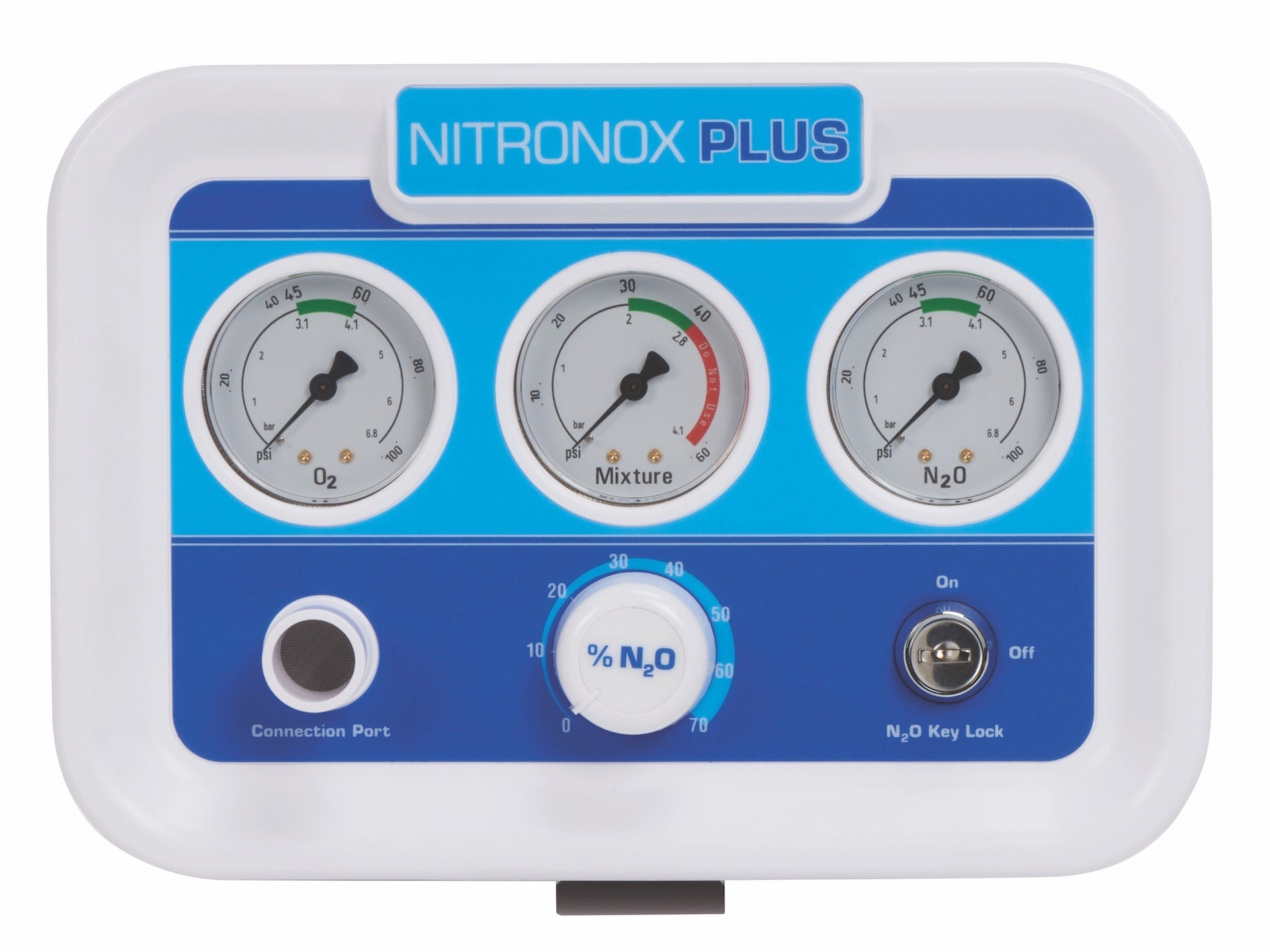
An office BPH suite adds only the analgesia hardware to its existing Rezūm or UroLift setup. Core additions: the Nitronox Plus delivery system with single-use patient breathing circuit, a scavenging attachment routed to the room ventilation exhaust, and a pulse oximeter. The Nitronox Plus product page and the broader pain and anxiety management collection cover the hardware. The Rezūm generator and disposable delivery device or the UroLift delivery device and implants are unchanged from the manufacturer-specified configuration.
Procedural Workflow — Additive Pattern
The workflow below layers nitrous oxide on top of the standard oral-plus-local anesthesia pattern for either Rezūm or UroLift. Follow the manufacturer instructions for use for all procedure-specific steps.
- Consent and eligibility confirmation. Two separate consents: the standard BPH procedure consent per AUA guideline, and a separate cash-pay comfort service consent for the nitrous oxide.
- Oral pre-medication. Administer alprazolam 1 to 2 mg and hydrocodone with acetaminophen 5 to 10 mg one hour before the procedure per the Rezūm or UroLift office protocol the practice uses.
- Baseline vitals. Record baseline pulse and oxygen saturation. IV access is optional per institutional protocol; minimal sedation with self-administered N₂O does not itself require IV access.
- Prostate block. Deliver the traditional or modified prostate block with 1 percent lidocaine per the Ulchaker and Beahrs technique. Confirm adequate anesthetic dwell time (typically 15 to 20 minutes) before beginning the procedure.
- Topical urethral lidocaine. Instill 10 to 20 mL of 2 percent lidocaine jelly and hold with a penile clamp for two to three minutes.
- Initiate nitrous oxide. The patient self-administers the mask. Titrate to comfort within the device-labeled range at or below 50 percent N₂O in oxygen. Confirm the scavenging system is capturing exhaled gas at the mask before proceeding.
- Cystoscopic access and treatment delivery. Perform the Rezūm vapor injections or the UroLift implant deliveries per the manufacturer’s IFU and the practice’s standard technique. The nitrous oxide is delivered continuously through the active treatment phase.
- Catheter placement (Rezūm) or immediate voiding trial (UroLift). Rezūm patients typically leave the office with an indwelling catheter for three to seven days. UroLift patients typically void before discharge without a catheter. Follow the manufacturer’s IFU and institutional protocol.
- Nitrous oxide discontinuation and recovery. Discontinue N₂O delivery, keep the patient on 100 percent oxygen for one to two minutes to accelerate washout, then remove the mask. Recheck pulse and oxygen saturation.
- Discharge. Confirm the patient is alert, oriented, ambulatory, and asymptomatic. Because the additive pattern includes an oral opioid and an oral benzodiazepine, the patient will require a driver home per the standard Rezūm and UroLift office pattern.
Note that step 10 illustrates why the substitutive pattern (nitrous oxide in place of the oral anxiolytic) is attractive for selected patients: if the oral opioid and benzodiazepine are removed, the patient can drive home per the standard N₂O offset. The trade-off is that the substitutive pattern may not deliver the same combined analgesia and anxiolysis as the standard oral-plus-local protocol. The operator selects the pattern based on the patient’s needs and risk profile.
Reimbursement — 2026 CPT Framework
Rezūm and UroLift each have their own CPT structure, and the nitrous oxide comfort service is separate from either procedure code.
CPT 53854 — Water Vapor Thermal Therapy (Rezūm)
Describes transurethral destruction of prostate tissue by radiofrequency-generated water vapor thermotherapy. CY2026 CMS national average from the CMS Physician Fee Schedule search tool: $3,395.54 non-facility, $354.05 facility. The large non-facility-to-facility differential reflects the office practice expense including the single-use device (which is a significant cost element). Site of service and payer contracts should be verified per patient.
CPT 52441 and +52442 — UroLift Primary and Add-On
52441 describes cystourethroscopy with insertion of a permanent adjustable transprostatic implant, single implant, and +52442 is the add-on for each additional implant beyond the first. Most UroLift cases use four to six implants, meaning one 52441 and three to five +52442 add-ons per case. CY2026 CMS national averages: 52441 $1,245.19 non-facility / $184.04 facility; +52442 $864.42 non-facility / $44.09 facility. As with 53854, the non-facility-to-facility spread reflects device and single-use inventory carrying costs that stay with the office.
Nitrous Oxide — Cash-Pay Only
No CPT code exists for nitrous oxide gas administration in adult urology. As documented in a 2024 Urology Times reimbursement column by Rubenstein and Painter, and per the ASA Continuum of Depth of Sedation, patient-self-administered nitrous oxide at 50 percent or less N₂O in oxygen with no other sedative is minimal sedation and is not eligible for the moderate-sedation CPT codes 99151 through 99157. For urology procedures, nitrous oxide use is a noncovered service. The service is structured as a cash-pay comfort offering with a Good Faith Estimate per the No Surprises Act framework, detailed in the cash-pay nitrous oxide comfort service guide.
Documentation Requirements
Documentation has two parallel tracks: the procedure record (consent, oral pre-medication dose and time, prostate block detail, treatment parameters per manufacturer IFU, catheter management, complications) and the comfort service record (eligibility screen, comfort consent, gas start and stop times, peak concentration, tolerance note).
Framing to Patients
Frame the offering as an optional comfort adjunct that some patients prefer, layered on top of the established local-plus-oral protocol. Practices should not market the modality as reducing pain or anxiety for Rezūm or UroLift specifically — no trial supports that claim. Patients who ask for BPH-specific evidence should be told directly that the general N₂O profile in office urology is well documented, but Rezūm- and UroLift-specific trial evidence has not yet been published. This framing preserves credibility.
Quick-Reference Card — Office BPH Nitrous Oxide Comfort Adjunct
| Office BPH Therapy — Nitrous Oxide Comfort Adjunct Quick Reference | |
|---|---|
| Category | Value |
| Standard primary analgesia (Rezūm) | Oral alprazolam ± hydrocodone-acetaminophen + prostate block + topical lidocaine |
| Standard primary analgesia (UroLift) | Topical lidocaine ± prostate block ± oral sedation (per operator) |
| Role of nitrous oxide | Comfort adjunct only, not primary analgesic |
| BPH-specific N₂O RCT | None published as of this writing |
| N₂O concentration | Titrate up to 50 percent in oxygen; patient-self-administered |
| ASA sedation level (N₂O alone) | Minimal (at ≤50 percent N₂O with no other sedative) |
| ASA level with additive oral opioid + benzodiazepine | Confirm remains minimal per ASA definition; individualized |
| Driver required (additive pattern) | Yes, because of oral premedication |
| Driver required (substitutive pattern) | No, if N₂O replaces oral anxiolytic and only local anesthesia is retained |
| CPT 53854 (Rezūm) — 2026 CMS | $3,395.54 non-facility / $354.05 facility |
| CPT 52441 (UroLift primary) — 2026 CMS | $1,245.19 non-facility / $184.04 facility |
| CPT +52442 (UroLift add-on) — 2026 CMS | $864.42 non-facility / $44.09 facility |
| Nitrous oxide reimbursement | Cash-pay; noncovered by medical payers |
| Consent | Separate procedure + comfort-service consent |
| Good Faith Estimate | Required per No Surprises Act |
| Marketing framing | Optional comfort adjunct; no efficacy claim for BPH specifically |
Frequently Asked Questions
Does nitrous oxide replace the oral pre-medication?
In the additive pattern, no. Nitrous oxide is layered on top of the standard oral alprazolam plus hydrocodone-acetaminophen and the prostate block. In the substitutive pattern, N₂O may replace the oral anxiolytic in carefully selected patients, but the local anesthetic and prostate block remain the primary analgesia.
Can a Rezūm or UroLift patient drive home if nitrous oxide is used?
It depends on the pattern. In the additive pattern, the patient received an oral benzodiazepine and an oral opioid and cannot drive; the driver requirement is unchanged from the standard office BPH protocol. In the substitutive pattern (N₂O instead of oral sedation), the patient can drive per the standard N₂O offset. The consent conversation should make the driver policy explicit.
Is there a BPH-specific nitrous oxide RCT?
No randomized trial of nitrous oxide versus the standard oral-plus-local pattern for Rezūm or UroLift has been published as of this writing. The general nitrous oxide safety and analgesic profile in office urology is documented across cystoscopy, prostate biopsy, and ureteral stent literature, but the BPH-specific extrapolation is inferential.
Does the prostate block replace nitrous oxide?
The prostate block is the primary local analgesic for the intra-glandular pain of vapor injection or implant deployment. Nitrous oxide is a comfort adjunct, not a substitute for the block. The block remains standard per the Rezūm 2019 CJU technique paper and the UroLift 2025 systematic review.
How is the cash-pay comfort fee set for a Rezūm or UroLift patient?
The cash-pay comfort fee is structured around the practice’s cost of delivering the nitrous oxide service (gas, single-use circuit, staff time, room time), independent of the underlying procedure fee. Because Rezūm and UroLift both have longer room times than a diagnostic cystoscopy, the comfort fee is typically set at a higher level than the cystoscopy comfort fee. The full fee-setting framework is in the cash-pay nitrous oxide comfort service guide.
Where does this fit in the Minerva urology cluster?
This is the office BPH installment. The general framework, exclusions, and evidence overview live in the pillar guide. The reimbursement structure for the cash-pay comfort service lives in the cash-pay article. The stronger-evidence procedure articles (cystoscopy, prostate biopsy, ureteral stent) provide the general nitrous oxide safety and analgesic profile that supports offering the modality in a Rezūm or UroLift program.
This article is for informational purposes for healthcare professionals. It does not constitute medical advice or replace clinical judgment. Always follow your institution’s protocols and the manufacturer’s instructions for use for the Rezūm and UroLift devices. No randomized controlled trial of nitrous oxide versus standard oral sedation with local anesthesia for Rezūm or UroLift has been published as of this writing; the framework described here relies on general office urology nitrous oxide safety data and on the published anesthesia patterns for each procedure.