
Office vasectomy is one of the most commonly performed male urology procedures and is routinely completed under local anesthesia alone, typically using a lidocaine spermatic cord block or a no-needle jet-injection technique. The American Urological Association (AUA) vasectomy guideline explicitly permits additional sedation when local anesthesia alone is expected to be inadequate for a particular patient. For practices that already offer nitrous oxide analgesia elsewhere in the clinic, vasectomy is a natural additional setting where the modality can be offered to interested patients as a cash-pay comfort adjunct. This guide explains where nitrous oxide fits in the AUA framework, what the published evidence does and does not say about vasectomy specifically, the CPT 55250 reimbursement structure, and how to structure the offering as a patient comfort service.
The AUA Framework for Vasectomy Anesthesia
The American Urological Association Vasectomy Guideline states directly that vasectomy should be performed with local anesthesia with or without oral sedation. If the patient declines local anesthesia, or if the surgeon believes that local anesthesia with or without oral sedation will not be adequate for a particular patient, the guideline permits intravenous sedation or general anesthesia. The guideline does not name every possible adjunct, but the framework is clear: local anesthesia is the standard, and additional modalities are permitted when the surgeon-patient assessment supports them.
Patient-self-administered nitrous oxide at 50 percent or less in oxygen with no other sedative sits inside the American Society of Anesthesiologists (ASA) minimal-sedation category. It is below the moderate-sedation threshold that triggers CPT 99151-99157 documentation and monitoring requirements. Nitrous oxide is not a replacement for local anesthesia; the local anesthetic remains the primary analgesic for the incisional and vas-manipulation pain of the procedure. Where nitrous oxide can be offered is as an additional comfort adjunct for the patient who is anxious about the procedure, who has previously had a difficult experience with local-only vasectomy, or who would otherwise decline the office setting entirely and shift to the operating room.
What the Evidence Does and Does Not Say
The Gopalakrishna 2020 review of nitrous oxide in office urology (Urology) lists vasectomy among the candidate procedures where nitrous oxide has been used and where additional study is warranted. The review does not identify a randomized controlled trial of nitrous oxide versus local anesthesia alone for vasectomy specifically. As of this writing, no such trial has been published. The framework for adding nitrous oxide to a vasectomy program therefore rests on three points: the general safety and analgesic profile of nitrous oxide established across other office urologic procedures and described in the pillar guide to office urology nitrous oxide analgesia, the AUA guideline’s explicit permission for additional modalities when clinically indicated, and the patient’s own request for a comfort service beyond local anesthesia alone.
Practices that adopt nitrous oxide as a vasectomy comfort adjunct should frame the offering to patients and to internal stakeholders accordingly. The modality is offered because the patient prefers it, not because the practice is claiming a specific analgesic benefit for vasectomy that has been demonstrated in a randomized trial. This framing is both accurate and legally cleaner than an unsupported efficacy claim.
Patient Selection
Two selection layers apply for offering nitrous oxide as a vasectomy comfort adjunct.
Vasectomy candidacy itself follows the standard AUA workup: counseling on permanence, discussion of alternatives, and confirmation of decisional capacity. The addition of nitrous oxide does not change this workup.
Nitrous oxide eligibility follows the standard Nitronox Plus device instructions for use (IFU) and the ASA minimal-sedation framework: no pneumothorax or bowel obstruction, no recent middle ear or intraocular surgery, no vitamin B12 deficiency for prolonged or repeat exposures, and no chronic opioid or benzodiazepine use that would push a patient beyond minimal sedation when combined with N₂O. Patients on chronic supplemental oxygen or with severe COPD warrant individualized review. The full eligibility checklist appears in the pillar guide.
Room Setup and Equipment
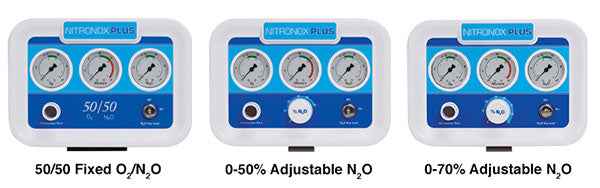
An office vasectomy room that adds nitrous oxide requires only the analgesia hardware; the vasectomy instrument tray does not change. Core additions: the Nitronox Plus delivery system with single-use patient breathing circuit, a scavenging attachment routed to the room ventilation exhaust, and a pulse oximeter. The Nitronox Plus product page and the broader pain and anxiety management collection cover the hardware. The vasectomy tray (local anesthetic setup, no-scalpel vasectomy instruments or scalpel and hemostats, occlusion supplies) is unchanged from the practice’s existing pattern.
Procedural Workflow with Nitrous Oxide Added
The workflow below adds nitrous oxide to a standard local-anesthetic office vasectomy. The local anesthetic remains the primary analgesic; nitrous oxide is layered in for patient comfort.
- Consent for vasectomy and comfort service. Two separate consents: the standard vasectomy consent per AUA guideline, and a separate cash-pay comfort service consent for the nitrous oxide.
- Eligibility screen. Confirm nitrous oxide exclusions and confirm the patient understands nitrous oxide is being offered as a comfort adjunct, not as a substitute for local anesthesia.
- Baseline vitals. Record baseline pulse and oxygen saturation. No IV access is required for minimal sedation.
- Positioning and prep. Position, prep, and drape per the practice’s standard vasectomy setup.
- Initiate nitrous oxide. The patient self-administers the mask. Titrate to comfort within the device-labeled range at or below 50 percent N₂O in oxygen. Confirm the scavenging system is capturing exhaled gas at the mask before proceeding.
- Local anesthetic injection or jet delivery. Deliver local anesthesia per the practice’s standard technique (spermatic cord block, no-needle jet, or a combined approach).
- Vasectomy. Perform the vasectomy per the standard institutional technique (no-scalpel, conventional, or a hybrid approach). The nitrous oxide is delivered continuously throughout.
- Nitrous oxide discontinuation and recovery. Discontinue N₂O delivery, keep the patient on 100 percent oxygen for one to two minutes to accelerate washout, then remove the mask. Recheck pulse and oxygen saturation.
- Discharge. Confirm the patient is alert, oriented, ambulatory, and asymptomatic. Provide standard post-vasectomy instructions including scrotal support, activity restrictions, and semen analysis timing. Patients drive themselves home when nitrous oxide is used per this pattern.
Reimbursement — 2026 CPT Framework
Vasectomy is billed per the standard CPT 55250 code regardless of whether nitrous oxide is offered. The nitrous oxide comfort service is billed separately as cash-pay.
CPT 55250 — Vasectomy, Unilateral or Bilateral, Including Postoperative Semen Examination
Describes bilateral vasectomy including the postoperative semen examinations required to confirm sterility. CY2026 CMS national average from the CMS Physician Fee Schedule search tool: $346.70 non-facility, $218.11 facility. Local adjustments and payer contracts vary. The code is bilateral by descriptor; unilateral vasectomy is unusual and requires the modifier and documentation specified by the payer.
Nitrous Oxide — Cash-Pay Only
No CPT code exists for nitrous oxide gas administration in adult urology, and the dental HCPCS code D9230 is not billable to Medicare or medical payers for urologic procedures. As documented in a 2024 Urology Times reimbursement column by Rubenstein and Painter, and per the ASA Continuum of Depth of Sedation, patient-self-administered nitrous oxide at 50 percent or less N₂O in oxygen with no other sedative is minimal sedation and is not eligible for the moderate-sedation CPT codes 99151 through 99157. For urology procedures, nitrous oxide use is a noncovered service. The service is therefore structured as a cash-pay patient comfort offering with a Good Faith Estimate delivered per the No Surprises Act framework detailed in the cash-pay nitrous oxide comfort service guide.
Documentation Requirements
Documentation for a vasectomy that includes nitrous oxide as a comfort adjunct has two parallel tracks: the standard vasectomy record (consent, technique, occlusion method, complications, follow-up plan for semen analysis) and the comfort service record. The comfort service record must include: nitrous oxide eligibility screen with exclusions verified, separate comfort service consent, start and stop times of gas delivery, peak N₂O concentration reached, and a brief note that the patient tolerated the delivery and returned to baseline within the expected offset window. This second track supports future audit of the cash-pay comfort offering.
How This Is Framed to Patients
Framing matters because the evidence base for vasectomy-specific nitrous oxide is thin. Practices should describe the offering as an optional comfort adjunct that some patients find useful, layered on top of the local anesthesia that does the primary work of the procedure. The offering should not be marketed as reducing pain or anxiety specifically for vasectomy, because no randomized trial supports that specific claim. Patients who ask for pain and anxiety data should be told directly that the general nitrous oxide evidence in office urology is strong, but vasectomy-specific trial evidence has not yet been published. This is both accurate and preserves the practice’s credibility when the patient encounters conflicting content online.
Quick-Reference Card — Vasectomy Nitrous Oxide Comfort Adjunct
| Vasectomy — Nitrous Oxide Comfort Adjunct Quick Reference | |
|---|---|
| Category | Value |
| Primary analgesic | Local anesthesia (spermatic cord block or no-needle jet) |
| Role of nitrous oxide | Comfort adjunct only, not primary analgesic |
| Vasectomy-specific N₂O RCT | None published as of this writing |
| AUA guideline permits adjuncts? | Yes, when local ± oral sedation is inadequate |
| N₂O concentration | Titrate up to 50 percent in oxygen; patient-self-administered |
| ASA sedation level | Minimal (at ≤50 percent N₂O with no other sedative) |
| Driver required | No |
| CPT 55250 — 2026 CMS | $346.70 non-facility / $218.11 facility |
| Nitrous oxide reimbursement | Cash-pay; noncovered by medical payers |
| Consent | Separate vasectomy consent + comfort-service consent |
| Good Faith Estimate | Required per No Surprises Act |
| Marketing framing | Optional patient comfort adjunct; no efficacy claim for vasectomy specifically |
Frequently Asked Questions
Does nitrous oxide replace the local anesthetic?
No. The local anesthetic remains the primary analgesic and is required per the AUA vasectomy guideline framework. Nitrous oxide is an optional comfort adjunct layered on top.
Is there a vasectomy-specific nitrous oxide RCT?
No randomized trial of nitrous oxide versus local anesthesia alone for vasectomy has been published as of this writing. The general nitrous oxide safety and analgesic profile in office urology is well documented across cystoscopy, prostate biopsy, and ureteral stent literature, but the vasectomy-specific extrapolation is inferential.
Why offer nitrous oxide if the RCT evidence is not there?
Because some patients ask for a comfort adjunct beyond local anesthesia and prefer nitrous oxide to oral sedation for its rapid offset and no-driver requirement. The AUA framework permits adjuncts when the surgeon-patient assessment supports them, and the general safety profile is well established. Practices offering the modality frame it as a patient-preference comfort service, not as an evidence-based pain-reduction claim for vasectomy specifically.
Can a patient use nitrous oxide instead of the vasectomy consent-required sedation discussion?
No. Nitrous oxide does not substitute for the standard vasectomy consent conversation, which per AUA guidelines includes discussion of local anesthesia as the standard, and the option of intravenous sedation or general anesthesia if local is inadequate. The nitrous oxide conversation is additive.
How does the cash-pay comfort fee for vasectomy nitrous oxide compare to other procedures?
Because the fee is structured around the practice’s cost of delivering the service (gas, single-use circuit, staff time, room time), and vasectomy takes similar room time to a diagnostic cystoscopy in most practices, the fee is typically set at the same level as the cystoscopy comfort service. The full fee-setting framework is in the cash-pay nitrous oxide comfort service guide.
Where does this fit in the Minerva urology cluster?
This is the vasectomy-specific installment. The general framework, exclusions, and evidence overview live in the pillar guide. The reimbursement structure for the cash-pay comfort service lives in the cash-pay article. The stronger-evidence procedure articles (cystoscopy, prostate biopsy, ureteral stent) provide the general nitrous oxide safety and analgesic profile that supports offering the modality in a vasectomy program.
This article is for informational purposes for healthcare professionals. It does not constitute medical advice or replace clinical judgment. Always follow your institution’s protocols and the manufacturer’s instructions for use. No randomized controlled trial of nitrous oxide versus local anesthesia alone for vasectomy has been published as of this writing; the framework described here relies on general office urology nitrous oxide safety data and the AUA vasectomy guideline’s explicit permission for anesthetic adjuncts when clinically indicated.