
Prostate biopsy is the urology office procedure with the most active reimbursement change and the most current published evidence for nitrous oxide analgesia. Effective January 1, 2026, CPT 55700 is deleted and replaced by a new family of nine codes spanning 55705 through 55715, each differentiated by approach, imaging, and lesion targeting. At the same time, Escobar and colleagues in the Journal of Urology (2024) reported that patient-adjusted nitrous oxide at 20 to 45 percent is a safe adjunct that lowers procedural pain and improves urologist-rated tolerance without requiring a driver. This guide walks urologists through the current evidence, the new code structure, and the workflow for adding a cash-pay nitrous oxide comfort service to an office biopsy program.
Why Nitrous Oxide Belongs in the Biopsy Suite
Prostate biopsy fits nitrous oxide well: the procedure is uncomfortable for a meaningful minority despite periprostatic block, the discomfort is discrete to the ten- to twenty-minute active sampling window, and patients typically drove themselves in and expect to drive themselves home. Nitrous oxide onset in one to two minutes and offset in a similar window after mask discontinuation fits that tempo far better than any oral sedative, and it stays inside the American Society of Anesthesiologists (ASA) minimal-sedation category at 50 percent or less in oxygen with no other sedative. The Escobar 2024 trial confirmed the practical point directly — patients were allowed to drive home independently. The full framework across urology procedures is covered in the pillar guide to office urology nitrous oxide analgesia.
Evidence Base for Prostate Biopsy Specifically
The most current biopsy-specific evidence comes from Escobar and colleagues, published in the Journal of Urology in February 2024. The single-institution, prospective, double-blind, randomized controlled trial enrolled 133 patients undergoing transrectal prostate biopsy, randomized 66 to self-adjusted nitrous oxide at concentrations between 20 and 45 percent and 67 to oxygen, with all patients receiving routine periprostatic bupivacaine block. The primary anxiety endpoint — State-Trait Anxiety Inventory and a visual analog scale for anxiety — showed no significant difference between groups. The secondary pain endpoint favored nitrous oxide with significantly lower visual analog pain scores (P=0.026), and the blinded operating urologist rated procedure tolerance significantly better in the nitrous oxide group (P=0.03). Biopsy performance time did not differ. Complications were similarly low. Patients drove home independently. The authors concluded that patient-adjusted nitrous oxide at 20 to 45 percent is a safe adjunct during transrectal prostate biopsy.
The Escobar trial extends earlier randomized evidence from Cazarim and colleagues in PLoS One (2018), which studied a fixed 50 percent nitrous oxide-oxygen mixture in transrectal ultrasound-guided prostate biopsy and reported reduced pain versus control. The Gopalakrishna 2020 Urology review of nitrous oxide across urologic procedures identifies prostate biopsy as one of the strongest indications and reports adverse events as rare and self-limited. Together these three publications establish transrectal prostate biopsy as one of the two most-studied urologic indications for office nitrous oxide, alongside flexible cystoscopy.
Transperineal-specific RCT evidence for nitrous oxide is thinner. Both reference RCTs enrolled transrectal biopsy patients. Extrapolation to transperineal biopsy is clinically reasonable because the analgesic and anxiolytic mechanisms are independent of approach, but transperineal-specific RCT evidence is not yet published.
The 2026 CPT Restructure — What Changed
Effective January 1, 2026, per the AUA’s CY2026 MPFS Deep Dive Summary, the CPT Editorial Panel deleted CPT 55700, revised CPT 55705, and created nine new Category I codes. The new family covers every combination of approach, imaging, and targeting used in current practice, and it bundles all imaging guidance directly into each code.
The single most important operational change: CPT 76872 (transrectal ultrasound) and CPT 76942 (ultrasound needle guidance) are no longer separately reportable with any 55705-55715 code — a hard bundling rule enforced by NCCI edits. CT and MRI guidance codes for in-bore procedures are also bundled. Any 2026 claim that still reports 55700 will be denied; the code is invalid and payers will not crosswalk it. The AUA has noted concerns about clarity of the new code set and expects further revisions for 2027.
The 2026 Prostate Biopsy Code Table
| Code | Approach | Imaging | Descriptor summary |
|---|---|---|---|
| 55700 | — | — | DELETED effective 1/1/2026 — do not use |
| 55705 | Any | None | Incisional biopsy, nonimaging-guided (revised descriptor) |
| 55706 | Transperineal | Template grid | Stereotactic template-guided saturation (unchanged) |
| 55707 | Transrectal | US only | Sextant or US-localized discrete lesion(s) |
| 55708 | Transrectal | US + MRI-fusion | Ultrasound-guided with MRI-fusion, first targeted lesion |
| 55709 | Transperineal | US only | Sextant or US-localized discrete lesion(s) |
| 55710 | Transperineal | US + MRI-fusion | Ultrasound-guided with MRI-fusion, first targeted lesion |
| 55711 | Transrectal | MRI-US fusion | Targeted lesion(s) only, first targeted lesion |
| 55712 | Transperineal | MRI-US fusion | Targeted lesion(s) only, first targeted lesion |
| 55713 | In-bore | CT or MRI | Sextant with additional targeted lesion(s), first lesion |
| 55714 | In-bore | CT or MRI | Targeted lesion(s) only, first targeted lesion |
| +55715 | Add-on | Fusion or in-bore | Each additional targeted lesion (add-on to 55708-55714) |
Imaging codes CPT 76872 and CPT 76942 are bundled into every code in the 55705-55715 family and cannot be reported separately. NCCI edits enforce this.
Patient Selection
Nitrous oxide is a reasonable adjunct to offer any adult patient scheduled for office prostate biopsy who does not fall into a contraindication category. The strongest candidate groups are patients undergoing repeat biopsy after a prior painful experience, anxious first-time patients, patients on active surveillance with a scheduled cadence of biopsies, and patients who cannot arrange transportation for a moderate-sedation encounter.
Nitrous Oxide Plus Periprostatic Block — the Combined Standard
Nitrous oxide supplements periprostatic nerve block; it does not replace it. Both the Escobar 2024 and Cazarim 2018 trials delivered nitrous oxide on top of standard periprostatic bupivacaine or lidocaine block — the reported pain reductions were incremental over that baseline. That is the operational standard: the practice’s usual local anesthesia protocol (typically 10 mL of 1 percent lidocaine or a bupivacaine equivalent injected periprostatically under ultrasound guidance) delivered first, with the nitrous oxide mask fitted and self-administered starting one to two minutes before the first core is taken. Removing the periprostatic block to offer nitrous oxide alone is not evidence-supported.
Room Setup and Equipment
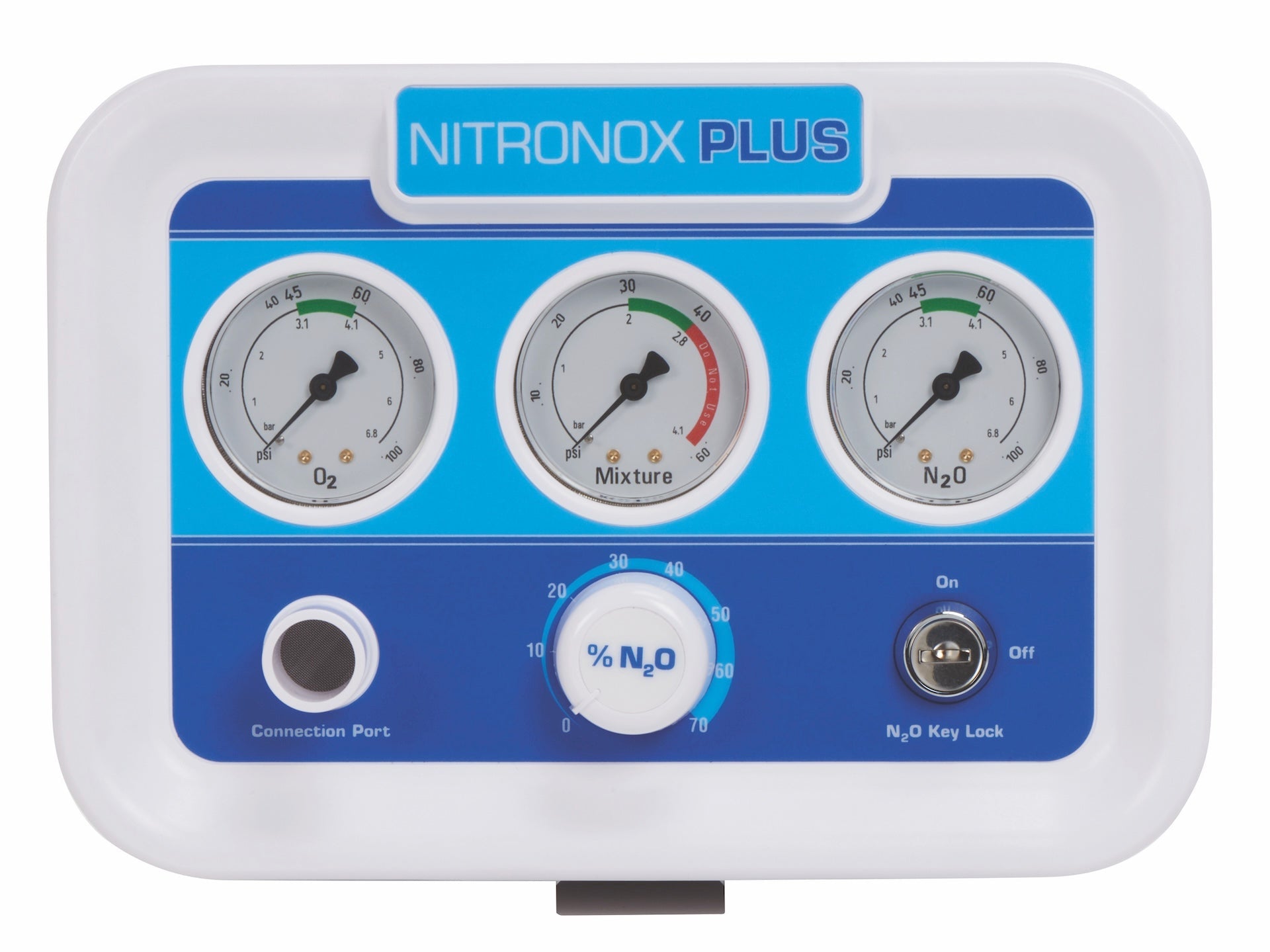
A prostate biopsy room that adds a nitrous oxide program needs the same three additions as any office nitrous oxide setup: the delivery device, an active scavenger, and a documented occupational-exposure monitoring approach. The Nitronox Plus nitrous oxide system, cleared under FDA 510(k) K113687 for spontaneously breathing patients requiring analgesia, is available in fixed 50/50 and adjustable configurations with adult masks, disposable circuits, and a matched scavenger. The Escobar 2024 trial used a self-adjustable delivery device titrated between 20 and 45 percent, which is the specific device configuration best supported by current biopsy-specific RCT evidence — but the fixed 50/50 configuration is also a defensible choice that stays inside the ≤50 percent ASA minimal-sedation ceiling by design.
Occupational exposure to nitrous oxide is regulated by the NIOSH Pocket Guide REL of 25 ppm time-weighted average. Every biopsy room offering nitrous oxide needs an active scavenger connected to the delivery device, adequate room air exchange, and periodic personal or area dosimetry, plus inclusion of biopsy staff in the practice’s occupational exposure monitoring program. Additional devices and disposables are catalogued in the pain and anxiety management collection.
Procedural Workflow
The workflow below assumes standard office transrectal or transperineal prostate biopsy with periprostatic block and nitrous oxide at 50 percent or less in oxygen, self-administered, with no other sedative. Confirm every step against the device IFU and the practice’s own sedation policy.
- Pre-visit screening. Confirm no contraindication. Prostate biopsy patients frequently have age-related B12 concerns worth documenting explicitly.
- Consent. Two distinct consents — one for the biopsy per practice standard, one for the cash-pay nitrous oxide comfort service. Practice-setup and Good Faith Estimate framework are covered in the cash-pay comfort service guide.
- Baseline vitals. Heart rate, blood pressure, oxygen saturation. Continuous monitoring is not required at minimal sedation.
- Periprostatic block. Deliver the practice’s standard periprostatic anesthetic per protocol. Allow the standard onset time before core sampling.
- Initiate nitrous oxide. Fit the demand-flow mask, confirm seal, instruct the patient to breathe normally. If using an adjustable device, titrate per the Escobar 2024 protocol between 20 and 45 percent to the patient’s desired effect. If using a fixed 50/50 device, no titration is needed. Patient self-holds the mask.
- Perform the biopsy. Maintain verbal contact throughout. A patient who cannot respond appropriately to verbal commands has crossed out of minimal sedation and the encounter shifts to moderate-sedation protocol.
- Discontinue and administer 100 percent oxygen. Per StatPearls, 100 percent oxygen administration should follow nitrous oxide cessation to prevent diffusion hypoxia. Three to five minutes on 100 percent O₂ is standard.
- Post-procedure assessment. Confirm return to baseline mentation. Per the Escobar 2024 trial, patients at self-adjusted 20-45 percent were allowed to drive home independently. Confirm this against the practice’s own sedation policy.
- Document. Indication, contraindication screen, both consents, periprostatic block dose, nitrous oxide concentration (documented at ≤50 percent), start and stop times, absence of other sedatives, patient tolerance, adverse events.
Reimbursement — 2026 CPT Family Plus Cash-Pay Nitrous Oxide
The prostate biopsy itself is billed under the appropriate 2026 code from the 55705-55715 family — the specific code driven by approach, imaging, and lesion targeting per the table above. Under the Medicare Physician Fee Schedule, the biopsy is reimbursed per the payer’s fee schedule for the selected code. The AUA has noted concerns about the clarity of the new code set and is working with the CPT Editorial Panel toward revisions targeted for 2027, so practices should monitor for further updates.
For Medicare pathology, HCPCS G0416 remains the single inclusive code for prostate needle biopsy pathology regardless of core count. Private payers may follow CMS or require CPT 88305 by specimen count — verify payer-specific rules.
The nitrous oxide is not billed to insurance. Because self-administered nitrous oxide at ≤50 percent with no other sedative is classified as minimal sedation by the ASA continuum of sedation, moderate-sedation CPT codes 99151-99153 do not apply, and per Rubenstein and Painter in Urology Times (2024), “the use of nitrous oxide for urology procedures is a noncovered service.” No CPT or HCPCS code exists to report office nitrous oxide administration in urology. The service is offered cash-pay with the fee disclosed at scheduling. The pillar guide covers the full sedation-classification framework.
Two boundary conditions preserve minimal-sedation status: nitrous oxide concentration must remain at or below 50 percent (the Escobar 2024 trial’s 20-45 percent titration ceiling stays inside this by design), and no other sedative or analgesic — including oral anxiolytics — may be administered by any route in the same encounter. Local anesthesia (the periprostatic block) is compatible with minimal-sedation classification; an oral benzodiazepine or an IV sedative shifts the encounter to moderate sedation.
Quick-Reference Card — Office Prostate Biopsy Nitrous Oxide Program
| Office Prostate Biopsy + Nitrous Oxide — Program Elements | |
|---|---|
| Element | Setting or requirement |
| Deleted code (do not use) | CPT 55700 |
| 2026 biopsy code family | 55705 (nonimaging), 55706 (saturation), 55707-55714 (approach + imaging), +55715 (each additional targeted lesion) |
| Imaging bundling | 76872 and 76942 not separately reportable with any 55705-55715 code |
| Pathology (Medicare) | HCPCS G0416, inclusive of core count |
| Standard local anesthesia | Periprostatic block per practice protocol (typically 10 mL 1% lidocaine or bupivacaine equivalent) |
| Nitrous oxide concentration | ≤50% N₂O in O₂; Escobar 2024 titrated 20-45% for TRUS biopsy |
| Sedation classification | Minimal sedation per ASA (with periprostatic block only) |
| Concurrent oral or IV sedatives | None (any addition shifts to moderate sedation) |
| Nitrous oxide billing | Cash-pay comfort service; no CPT or HCPCS applies |
| Good Faith Estimate | Required for uninsured/self-pay commercial patients; not for Medicare/Medicaid/TRICARE/FEHB |
| Continuous pulse oximetry | Not required at minimal-sedation level; baseline vitals recommended |
| Independent trained observer | Not required at minimal-sedation level |
| Driver requirement | Not required per Escobar 2024 (self-adjusted 20-45% + periprostatic block); confirm against practice policy |
| Occupational exposure limit | NIOSH REL 25 ppm TWA; active scavenger + dosimetry required |
| Post-cessation oxygen | 100% O₂ for 3-5 minutes to prevent diffusion hypoxia |
Frequently Asked Questions
Does nitrous oxide replace periprostatic block?
No. Every published RCT supporting nitrous oxide for prostate biopsy — Escobar 2024, Cazarim 2018 — used it alongside standard periprostatic anesthesia. Removing the block to offer nitrous oxide alone is not evidence-supported. The two modalities work through complementary mechanisms and combine additively.
Is the evidence for transperineal biopsy as strong as for transrectal?
No. The reference RCTs enrolled transrectal biopsy patients. Clinically, the analgesic and anxiolytic mechanisms of nitrous oxide are independent of biopsy approach, so extrapolation is reasonable, but transperineal-specific RCT evidence is not yet published.
What concentration should we use — fixed 50/50 or adjustable 20-45 percent?
Both are defensible. The Escobar 2024 trial used self-adjusted 20-45 percent titration and is the most current biopsy-specific evidence. Fixed 50/50 stays inside the ASA minimal-sedation ceiling by design and is operationally simpler. Practices commonly choose the adjustable configuration when they want to align with the most current published protocol, and the fixed configuration when they want to minimize titration workflow.
Do biopsy patients need a driver home?
Per the Escobar 2024 protocol at self-adjusted 20-45 percent nitrous oxide with periprostatic block only, patients drove home independently. That aligns with the ASA minimal-sedation classification. Confirm against the practice’s own sedation policy and consider individual patient factors — age, comorbidities, distance driven — case by case.
Can we still bill CPT 76872 or 76942 with a 2026 biopsy code?
No. Every code in the 55705-55715 family bundles imaging guidance. NCCI edits will deny separate reporting of 76872 or 76942. This is a hard bundling rule as of January 1, 2026.
What if the patient asks for oral lorazepam plus nitrous oxide?
Adding an oral benzodiazepine shifts the encounter to moderate sedation under ASA definitions. Continuous pulse oximetry, an independent trained observer, and moderate-sedation documentation are all then required, and CPT 99151 or 99152 may become reportable if the full moderate-sedation documentation standard is met and the intra-service time threshold is documented. Most office biopsy programs decline this combination to preserve the minimal-sedation workflow and the drive-home logistics.
This article is for informational purposes for healthcare professionals. It does not constitute medical, coding, or legal advice, and it does not replace clinical judgment. Coding determinations for any specific claim require case-by-case review by qualified coders and the treating clinician. The 2026 CPT prostate biopsy code set is subject to further AMA revision; the AUA has stated it will work toward additional refinements for 2027.