
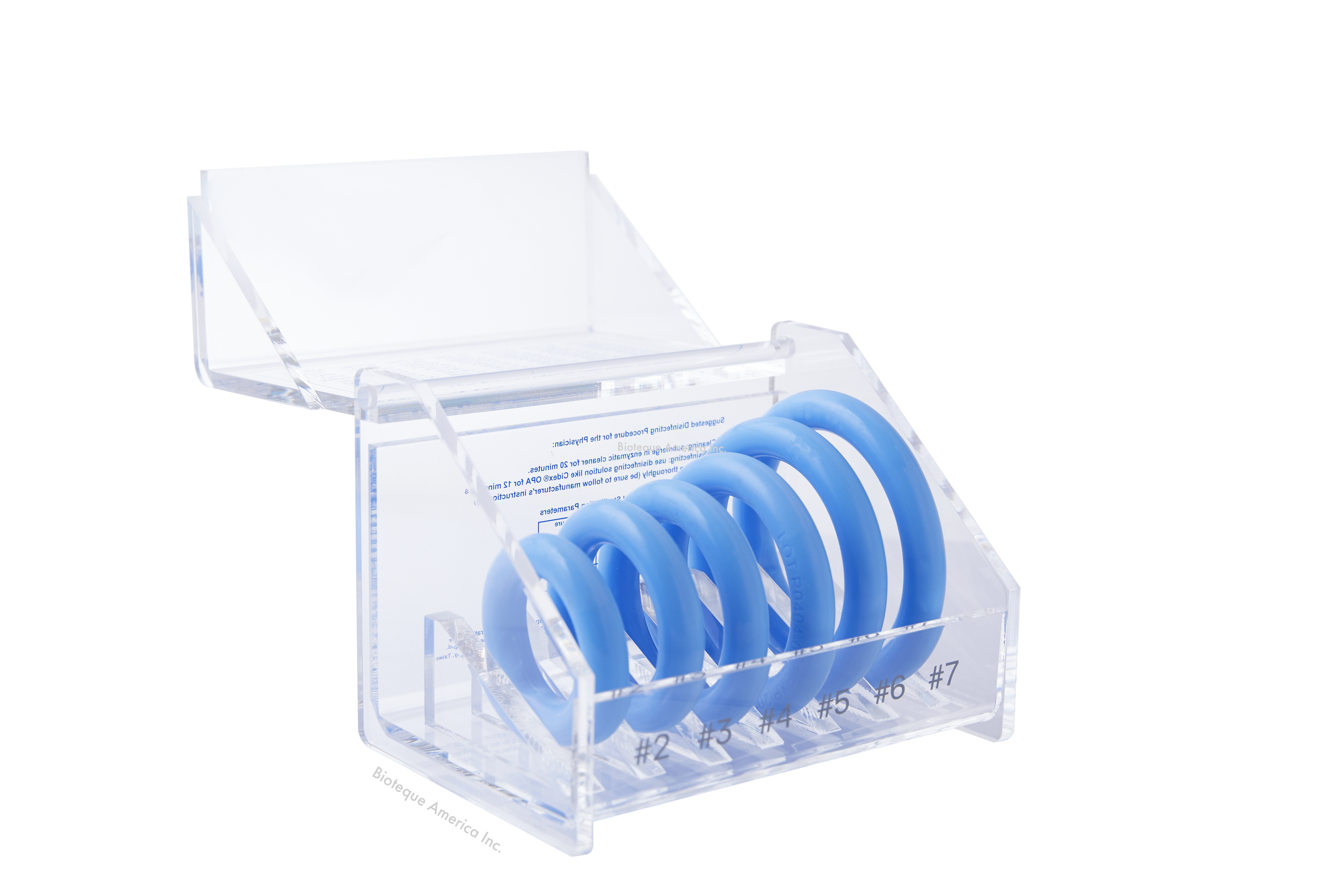
When apical support fails, the ring pessary that handles an early cystocele will expel repeatedly in a patient with stage III uterine prolapse. This guide covers the three space-filling shapes most relevant to uterine and apical prolapse: the Gellhorn, the Donut, and the Cube.
Apical Prolapse: Uterine Descent vs. Vaginal Vault Prolapse
Apical prolapse encompasses two presentations sharing the same pessary selection logic. Uterine prolapse occurs when the uterus is present and the cervix descends toward or through the introitus, classified on POP-Q by Point C relative to total vaginal length (TVL). Vaginal vault prolapse occurs after hysterectomy when the vaginal cuff descends. Both result from failure of the uterosacral-cardinal ligament complex and endopelvic fascia.
Clinically, patients report pelvic pressure, dragging heaviness, and symptoms that worsen with prolonged standing. Because apical support anchors both the anterior and posterior vaginal walls, advanced apical prolapse frequently coexists with cystocele and rectocele — an important consideration during fitting assessment.
Why Apical Prolapse Changes the Pessary Selection Logic
Support pessaries rest against the posterior fornix and the pubic symphysis. Once the apical compartment descends significantly, two anatomical changes undermine this mechanism:
- The posterior fornix is obliterated or displaced, removing the posterior ledge the ring needs to seat against.
- After hysterectomy, there is no cervix to help anchor the pessary — ring pessaries expel immediately or within hours in most vault prolapse patients.
A wide genital hiatus (GH ≥ 4 cm) compounds both problems. The combination of absent cervical support and wide GH is the clearest indication to skip the ring trial and begin directly with a Gellhorn pessary. The IUGA identifies prior hysterectomy as an independent risk factor for pessary fitting failure, attributable to shorter TVL, absent cervical support, and greater hiatal diameter.
Gellhorn Pessary — The Standard of Care for Apical and Uterine Prolapse
The Gellhorn is the most commonly prescribed space-filling pessary and the default first-line choice for moderate-to-advanced apical prolapse. Its firm circular silicone disc has a concave undersurface that creates suction against the vaginal walls; the central stem prevents rotation and facilitates clinician-assisted removal.
Indications: Stage III–IV uterine prolapse; post-hysterectomy vault prolapse; ring pessary expulsion despite correct sizing; GH ≥ 4 cm with any degree of apical descent; multicompartment prolapse with dominant apical component.
Sizing and removal: Most patients are fitted with a 2.5–3.0 inch Gellhorn; use the Gellhorn Fitting Set for systematic trial. Clinician removal is required for the majority of patients; a pessary removal aid (Pessary Assistant) simplifies the stem-grasp technique. Sexual intercourse is not possible with the device in situ.
The PESSRI trial (Cundiff et al., Am J Obstet Gynecol 2007; PMID 17403437) randomized 134 women with median POP-Q stage III to crossover between the ring with support and the Gellhorn. Both devices produced statistically and clinically significant improvements in PFDI and PFIQ scores, with no clinically significant difference between them. The authors concluded that fitting success and patient tolerance — not device hierarchy — should drive selection. When the ring with support is retained and tolerated, it need not be replaced; when it fails, the Gellhorn is the appropriate escalation.
Donut Pessary — Volume Support for Moderate–Severe Uterine Prolapse
The Donut pessary is a solid silicone torus that manages prolapse through volume displacement. When the uterus is present, the cervix rests within or behind the donut ring. It is indicated for stage II–III uterine prolapse (uterus in situ), larger genital hiatus where the ring has failed, and patients who decline the Gellhorn.
Limitations: The Donut is not compressible; insertion and removal are technically demanding and require clinician assistance. Sexual intercourse is not possible in situ. Discharge accumulation is less problematic than with the Cube because there are no concave surfaces. No fitting kit is available; order by measured vaginal ring diameter.
Cube Pessary — Space-Filling Option for Advanced Apical Prolapse
The Cube pessary is a flexible six-sided silicone device; each of the six concave faces creates suction against the vaginal walls. A retrieval string allows patient self-removal — making it the only major space-filling pessary that patients can learn to manage independently.
Indications: Stage III–IV prolapse where Gellhorn and Donut have both failed; severe anatomical distortion where disc-based pessaries cannot seat; patients who require self-management capability.
Critical consideration: Vaginal secretions accumulate in the concave faces, producing significant malodorous discharge without regular removal and cleaning. Daily or nightly self-removal is strongly recommended; instruct patients in cleaning technique at the first fitting visit. This hygiene requirement is the primary reason the Cube is a last-resort option rather than first-line. A Cube fitting set supports systematic size trialing.
Comparison: Gellhorn, Donut, and Cube for Apical Prolapse
| Feature | Gellhorn | Donut | Cube |
|---|---|---|---|
| Mechanism | Suction disc + central stem | Solid torus volume fill | Suction via 6 concave faces |
| Best for | Apical/uterine, vault, stage III–IV | Stage II–III uterine (uterus present) | Stage III–IV, last resort |
| Post-hysterectomy vault prolapse | First choice | Less preferred | Viable if Gellhorn fails |
| Self-management by patient | Usually requires clinician | No | Yes (string retrieval); nightly recommended |
| Sexual intercourse in situ | No | No | No |
| Discharge risk | Low–moderate | Low | High (daily cleaning required) |
| Fitting kit available | Yes | No — order by diameter | Yes |
Takeaway: The Gellhorn is the standard first-line space-filling pessary for uterine and apical prolapse. The Donut is an appropriate alternative when the uterus is present and the Gellhorn is not feasible or accepted. The Cube is reserved for stage III–IV cases where both the Gellhorn and Donut have failed.
Fitting Apical Prolapse — Clinical Workflow
Before fitting, confirm the bladder is empty, measure TVL and GH, manually reduce the prolapse, and inspect the vaginal mucosa for atrophy. Friable epithelium increases erosion risk with all space-filling devices; initiating local vaginal estrogen before or at the time of fitting and continuing it throughout pessary use is standard adjunct management. Confirm whether the uterus is present — this determines Donut viability.
The recommended fitting sequence for apical prolapse is Gellhorn first, then Donut, then Cube. Trial each with Valsalva and 5–10 minutes of ambulation. After fitting, perform a cough stress test: apical support frequently unmasks occult stress urinary incontinence that was masked by the prolapse-related urethral kinking. Document every shape and size trialed, Valsalva retention result, and patient-reported comfort.
Long-Term Management of Apical Prolapse with a Pessary
Patients using a Gellhorn or Donut require clinician-managed removal for cleaning and reinsertion. Per ACOG and AUGS guidance: initial follow-up at 1–2 weeks post-fitting, then every 3–6 months for clinician-managed devices; Cube users who self-remove nightly should attend clinical review every 3 months.
At each visit, inspect vaginal walls for erosion and ulceration. Any mucosal defect warrants device removal and topical estrogen before reinsertion. Long-term cohort data show that 30–50% of patients discontinue pessary use within 5 years (Lone et al., Int Urogynecol J, PMC3199042); annual reassessment of patient goals and surgical eligibility is appropriate.
Browse Minerva’s Prolapse Solutions collection for complete shape and size availability.
Frequently Asked Questions
What is the best pessary for uterine prolapse?
There is no single best pessary for all patients. For stage II–III with a moderate genital hiatus, a ring with support is often trialed first. For stage III–IV or ring failure, the Gellhorn is the standard space-filling escalation. The Donut is an alternative when the uterus is present. Selection should reflect TVL, GH, mucosal condition, and patient self-management ability rather than POP-Q stage alone.
Can a Gellhorn pessary be used after a hysterectomy?
Yes — the Gellhorn is the first-line choice for post-hysterectomy vault prolapse. Without a cervix to anchor a ring in the posterior fornix, support pessaries expel. The Gellhorn’s suction disc does not depend on the cervix for retention. Measure TVL carefully post-hysterectomy, as a shortened vaginal length constrains disc size selection.
How does a Gellhorn pessary stay in place?
The concave undersurface of the Gellhorn disc creates mild suction against the vaginal walls. The central stem prevents axial rotation. Together these features maintain position without requiring the pubic symphysis or cervix as structural anchors — which is why the Gellhorn succeeds where support pessaries fail. A disc that is too small will not generate adequate suction; one that is too large will cause mucosal pressure and discomfort.
Is the Cube pessary difficult for patients to manage?
The retrieval string makes self-removal feasible. Daily or nightly removal is strongly recommended to prevent discharge accumulation; instruct patients in cleaning and reinsertion at the first visit. For patients with limited dexterity or cognitive barriers, clinician-managed devices (Gellhorn, Donut) are the safer choice.
When should pessary management be escalated to surgery?
Surgical consultation is appropriate when all three space-filling shapes have failed, when the patient develops recurrent mucosal erosion, when prolapse is non-reducible, or when patient goals have shifted to definitive repair. ACOG supports offering surgery after failed pessary management; reassessment of surgical eligibility at each routine follow-up is a standard component of long-term care.
This article is for informational purposes for healthcare professionals. It does not constitute medical advice or replace clinical judgment. Always follow your institution’s protocols and the manufacturer’s instructions for use.